

A freelance graphic designer working out of a bedroom setup for four years — regular clients, decent Fiverr reviews, steady work — runs into a common wall: every rupee earned gets absorbed by household expenses, leaving nothing to invest back into the business.
The upgrade needed was modest by most standards: a proper workstation, licensed design software, a second monitor, a drawing tablet — around Rs. 250,000-300,000 total. Not a huge sum, but enough that self-funding it meant years of saving while opportunities kept slipping past.
A bank was the first stop. The bank wanted three years of business financials. What existed instead was a Fiverr profile and a personal account where client payments landed — not what a loan officer was looking for.
The PM Youth Business and Agriculture Loan Scheme exists for exactly this situation: young entrepreneurs whose businesses don’t fit the paperwork commercial banks expect. Skepticism was the first reaction — government schemes have a track record of underdelivering — but the application went in anyway.
Six months later, the loan came through. The workstation is running, and monthly revenue has nearly doubled, largely because projects that used to get declined for lack of equipment are now on the table.
The process wasn’t seamless. This guide walks through it exactly as it happened, gaps included.
What the PM Youth Loan Scheme Actually Is
The Prime Minister’s Youth Business and Agriculture Loan Scheme — commonly referred to as the PM Youth Loan Scheme or Kamyab Jawan Program — is a federal government initiative that provides subsidized financing to young Pakistanis aged 21 to 45 who want to start or expand a business.
The scheme is designed specifically for people who fall into the gap that Usman fell into: capable, working, with a real business idea or existing operation, but unable to access conventional bank credit because they lack the formal documentation that banks typically require.
What the scheme offers in 2026:
The scheme operates in tiers based on loan size:
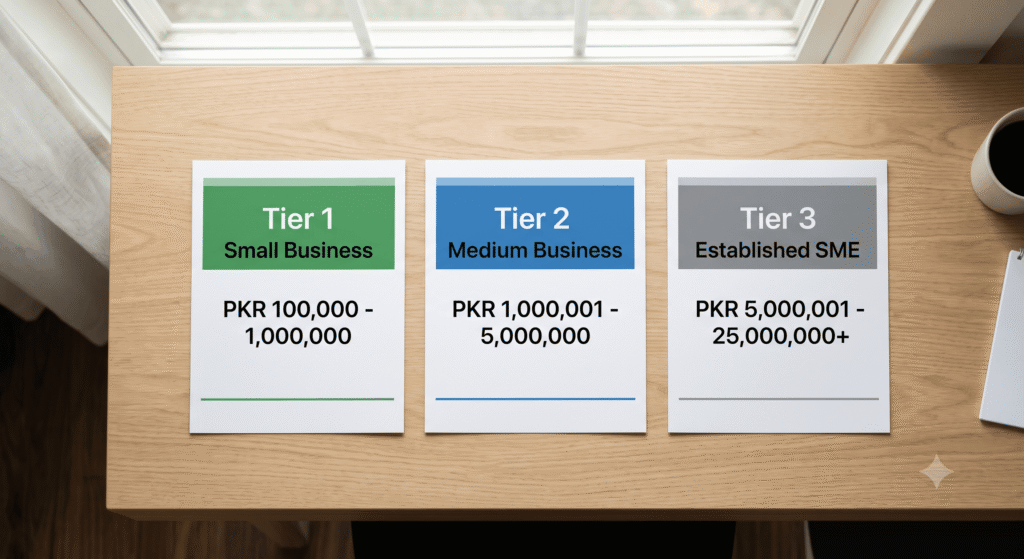
- Tier 1 (Small): Rs. 100,000 to Rs. 500,000 — for micro businesses, freelancers, small traders, and service providers
- Tier 2 (Medium): Rs. 500,001 to Rs. 1,500,000 — for small businesses with some operational history
- Tier 3 (Large): Rs. 1,500,001 to Rs. 7,500,000 — for established small enterprises looking to scale
The markup rate is heavily subsidized — typically 3% to 5% per annum for Tier 1, compared to 18–25% in the open market. Higher tiers have slightly higher subsidized rates but still significantly below commercial rates.
Loan tenures range from 3 to 8 years depending on the tier and the nature of the loan.
The scheme also has a dedicated component for agriculture — farmers and agri-businesses can access similar financing with different collateral and documentation requirements.
Who Is Eligible
Core criteria:
- Pakistani national with valid CNIC
- Age between 21 and 45 years
- The business idea or existing business must fall within an eligible sector (most sectors qualify — manufacturing, trade, services, agriculture, IT, and others)
- No history of loan default — ECIB check applies
- Must not already hold an active loan under the same scheme
Documents that support your eligibility:
- Educational certificate (minimum matriculation in most tiers, though this is a guideline rather than a hard cutoff)
- Proof of business or business intent
- CNIC matching your application details exactly
Priority categories:
- Women entrepreneurs (dedicated quota — typically 25% of loans reserved for women)
- Youth from lower-income backgrounds
- Applicants from smaller cities and rural areas
- Persons with disabilities (dedicated quota in some phases)
- Agriculture sector applicants in rural districts
A note on the “no formal business” situation: Tier 1 is specifically designed to accommodate people like Usman — where the “business” is a freelance operation, a home-based service, or a startup that hasn’t yet formalized. You don’t need a registered company or years of tax returns for Tier 1. You need a credible, coherent business plan and the ability to explain what you’ll do with the money.
How to Apply — Step by Step
Step 1: Go to pmkamyabjawan.gov.pk
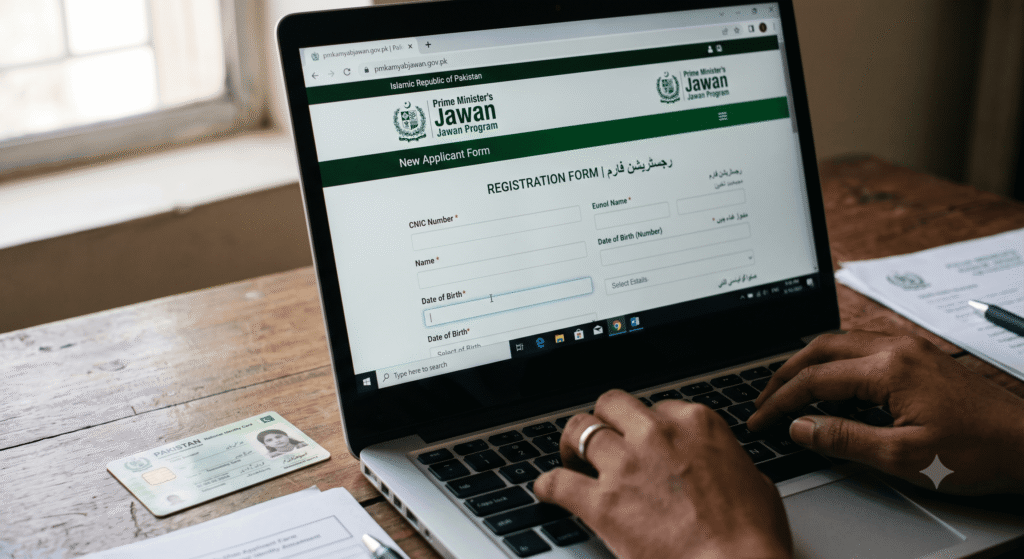
The official portal for the PM Youth Loan Scheme is pmkamyabjawan.gov.pk. This is where you start — not at a bank, not through a third party.
Create an account using your CNIC and a valid email address. The system will send a verification email — check your inbox (and spam folder) immediately.
Once verified, log in and begin filling your application profile.
Step 2: Choose Your Tier and Fill the Application
Select the tier that matches your loan requirement. Be realistic — don’t apply for Tier 2 if your business genuinely needs Tier 1 financing. The bank will assess your business and downgrade you anyway if the numbers don’t support it, which just adds delay.
The application form asks for:
- Personal information — CNIC, address, education, family details
- Business details — what the business does, how long it’s been running (or when you plan to start), where it operates or will operate
- Loan purpose — be specific. “Equipment upgrade for freelance design business” is better than “business expansion.” The more specific, the clearer your intent.
- Loan amount requested — with a breakdown of how it will be used
- Revenue and expense estimates — for existing businesses, provide realistic current figures. For startups, provide projected figures with a brief rationale.
Usman spent about two hours on the application form, going back and revising his business description several times until it clearly communicated what his freelance business was, what he’d buy with the loan, and how it would generate additional income to service the repayments.
That time investment paid off. The bank officer who later reviewed his application commented that his business description was unusually clear for a Tier 1 applicant.
Step 3: Submit and Wait for Bank Assignment
After submitting, the portal assigns your application to a partner bank in your area. The scheme’s partner banks include National Bank of Pakistan (NBP), Bank of Punjab (BOP), First Women Bank, Bank Alfalah, MCB Bank, and several others depending on your province and district.
You’ll receive notification of your assigned bank via email and SMS.
Step 4: Visit Your Assigned Bank Branch
Go to the specific branch assigned — not just any branch of that bank. Bring:
- Original CNIC
- Application reference number from the portal
- Business plan — if you have a written one, bring it. If not, be ready to verbally articulate the key points
- Bank statements — last 6 months if you have an account that shows business-related transactions

(Usman brought his personal account statements showing Fiverr payment deposits)
- Proof of business activity — in Usman’s case: screenshots of his Fiverr profile, client reviews, and his earnings history downloaded from the platform
- Business location details — if operating from home, a utility bill showing the address. If a shop/office, rental agreement or lease
- Educational certificates
At the branch, meet with the SME or consumer finance officer specifically assigned to the Kamyab Jawan program. This is important — not every officer in the branch handles this program, and going to the wrong person wastes time.
Step 5: Business Verification
The bank sends a field officer to verify your business. For home-based or freelance businesses (like Usman’s), this looks different from verifying a shop.
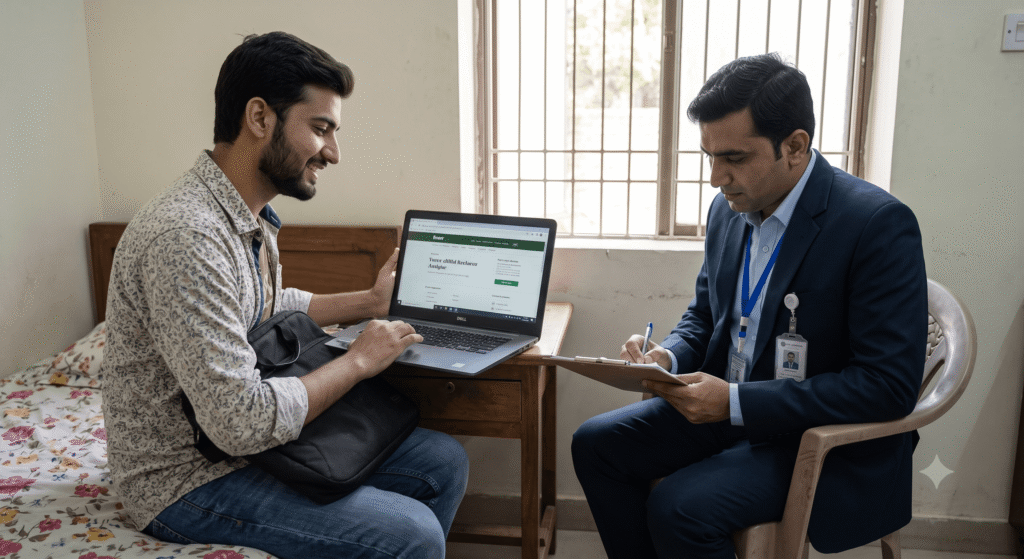
The field officer visited Usman at his home address. He showed them:
- His workstation setup
- His Fiverr account on his laptop, showing active orders and review history
- Screenshots of payment receipts from clients
- The receipt for his current (older) laptop, showing it was three years old and due for replacement
The officer photographed the setup and asked a few questions about the business model — how Usman found clients, typical project timelines, pricing. Usman answered straightforwardly.
Field verification for a home-based digital business is less about physical assets and more about demonstrating that the business is real and active.
Step 6: Credit Assessment and Decision
After the field visit, the bank’s credit team assesses:
- Your ECIB status (clean credit history)
- Business viability based on the field report
- Your ability to service the loan (monthly installment vs. demonstrated or projected income)
- Loan amount relative to the business’s demonstrated scale
For Tier 1, the assessment is simpler than for higher tiers. The bank is asking: is this person real, is the business real, and can they plausibly repay Rs. X over Y years given what we’ve seen?
Usman’s original request was Rs. 280,000. Approved amount: Rs. 250,000. The bank’s assessment was slightly conservative on his income projection. He accepted the Rs. 250,000 rather than appealing, because it was enough to cover the core equipment purchase.
Approval came in week 7 from his initial portal submission. The timeline from field visit to sanction letter was 3 weeks.
Step 7: Sanction Letter, Agreement, and Disbursement
The sanction letter outlines your approved loan amount, markup rate, tenure, monthly installment, and any conditions.
Read it carefully. Specifically:
- Confirm the markup rate matches what was communicated
- Understand the repayment start date (some loans have a 6-month grace period; others start immediately)
- Understand the penalty for late payments
- Check whether there are any conditions attached — “loan disbursement contingent on purchase invoice for equipment” is a common condition for equipment loans
After signing, disbursement happens — either directly to a vendor (for equipment purchases where the bank wants to verify use of funds) or to your account (for working capital).

Usman’s loan was disbursed in two parts: Rs. 180,000 directly to the computer hardware vendor (the bank required an invoice and paid the vendor directly), and Rs. 70,000 to his bank account for software licenses and accessories.
The Parts Nobody Tells You About
The portal sometimes goes down or times out. The pmkamyabjawan.gov.pk portal has historically had periods of heavy traffic — especially after major government announcements about the scheme. If you’re having trouble loading or submitting, try at off-peak hours (early morning or late night). Save your application as a draft regularly.
Your assigned bank branch might not be the nearest one. The portal assigns based on district and bank allocation, not pure proximity. If the assigned branch is inconvenient, you can sometimes request a transfer to a closer branch of the same bank — ask the branch manager about this. It’s not always possible, but it sometimes is.
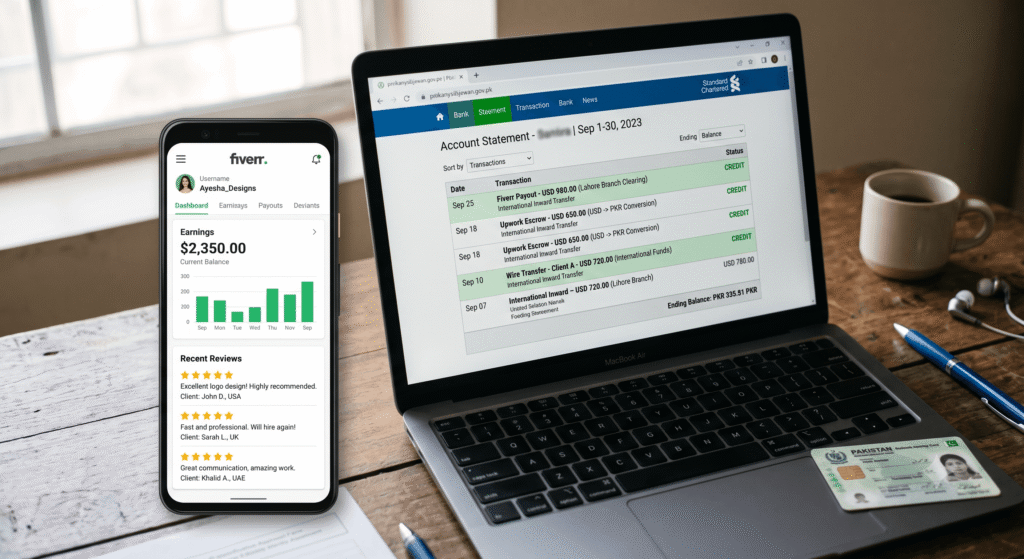
Fiverr, Upwork, and similar platform earnings are legitimate income for this scheme. A lot of freelancers don’t realize this. Your platform profile, earnings history exported from the platform, and bank statements showing deposits from these platforms are valid evidence of business income for Tier 1 applications.
The 25% women’s quota is real and worth knowing about. Female applicants genuinely have better approval odds because of the dedicated quota. If you’re helping a female family member or colleague who has a viable business idea, this scheme is particularly worth pursuing.
Mistakes That Delay or Kill Applications
Vague loan purpose. “I want to grow my business” tells the bank nothing. “I need Rs. 300,000 to purchase a workstation (Rs. 200,000), licensed software (Rs. 60,000), and drawing tablet (Rs. 40,000) to expand my graphic design freelance capacity” tells them everything. Be specific.
Not having any evidence of income or business activity. Even informal evidence helps. Fiverr screenshots, WhatsApp conversations with clients, supplier invoices, photos of your workshop — bring whatever you have that demonstrates the business is real.
Applying for a loan you can’t plausibly repay. The monthly installment on your requested loan amount should not exceed 40–50% of your demonstrable monthly income. If you’re earning Rs. 30,000 per month and applying for a loan with a Rs. 20,000 monthly installment, the math doesn’t work and the bank will see it immediately.
ECIB issues you didn’t know about. Check your credit status before applying. The State Bank of Pakistan’s consumer portal allows individuals to check their ECIB record. Old telecom installments, unpaid credit card minimums, informally settled loans — these can all show up.
Using a family member’s CNIC for a better application. The loan is registered in the applicant’s name and tied to their CNIC. Applying under someone else’s information is fraud, carries serious consequences, and defeats the purpose of a scheme designed to help the actual applicant build a credit history.
Not following up after field verification. The gap between field verification and sanction letter is where applications most commonly stall. Check in with your bank officer every 10–14 days during this period.
Quick Tier Reference
| Tier | Loan Range | Typical Markup | Suitable For |
|---|---|---|---|
| Tier 1 | Rs. 100K–500K | ~3–4% p.a. | Freelancers, micro businesses, home-based |
| Tier 2 | Rs. 500K–1.5M | ~4–5% p.a. | Small businesses with 1–3 years operation |
| Tier 3 | Rs. 1.5M–7.5M | ~5% p.a. | Established SMEs looking to scale |
Rates are approximate and subject to revision. Verify current rates at pmkamyabjawan.gov.pk or with your assigned bank.
Where Usman Is Now
Eight months after starting the application, Usman’s design setup is fully operational. The workstation he bought with the loan handles 3D rendering that his old laptop couldn’t touch. He’s taken on three recurring clients in the corporate communications space that he couldn’t have served before.
His monthly revenue went from an average of Rs. 55,000 to Rs. 95,000 in the months since the upgrade. His monthly loan installment is Rs. 5,200.
He still works from his bedroom in Rawalpindi. But

the bedroom now has a proper desk, dual monitors, a drawing tablet, and a business that’s growing instead of standing still.
The scheme didn’t hand him success. It removed the equipment bottleneck that was limiting what he could build. That’s what these loans are for — not to replace effort, but to stop effort from being wasted on limitations that money can solve.
If you’re in a similar position — real skills, real clients or prospects, but equipment or working capital holding you back — the PM Youth Loan Scheme is genuinely worth pursuing. Apply through the official portal, document your business properly, and be patient with the process.
It takes longer than it should. But it works.
Have a business idea but need financial support? The Prime Minister’s Youth Loan Scheme offers affordable financing to eligible young entrepreneurs. Visit the official portal below to review the loan tiers, check your eligibility, and apply online.
Apply for PM Youth Loan Scheme OfficialGot questions about your specific business type, the documentation you need, or how to handle a specific snag in the process? Leave a comment and we’ll try to help.