
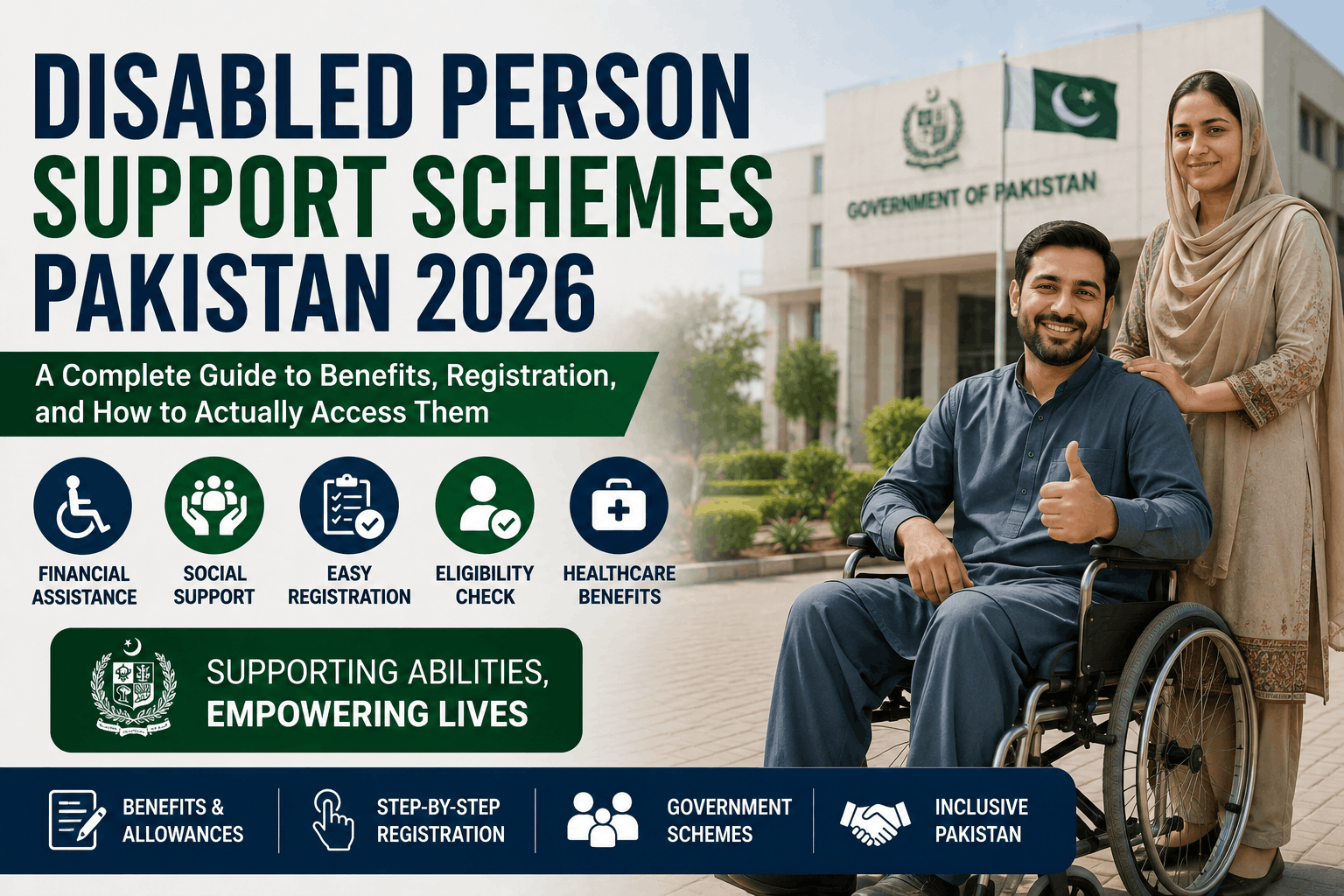
What actually happens to a person’s income when a disability makes their existing job impossible to keep?
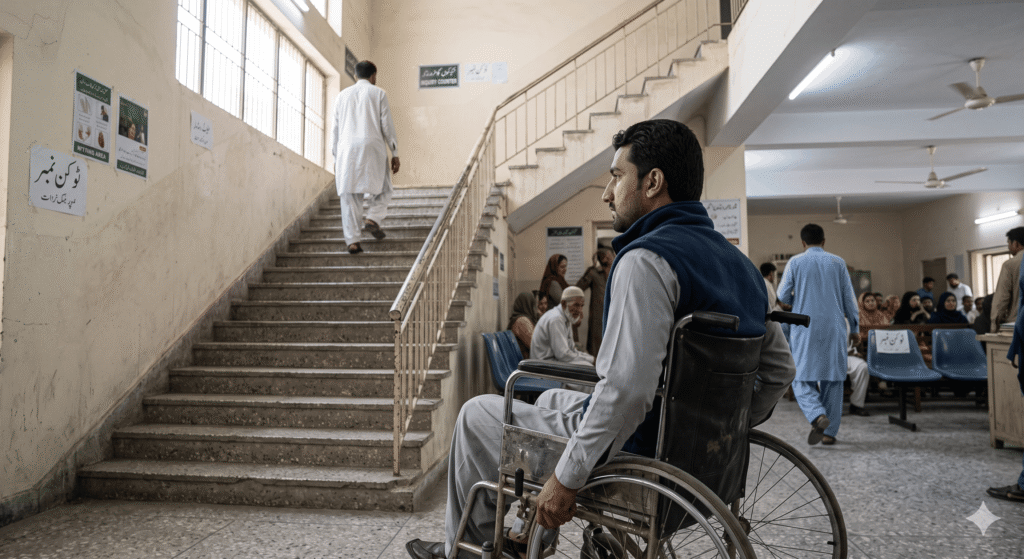
For one former schoolteacher, the answer came fast. A road accident left him using a wheelchair. The school had no ramp, no accessible bathroom, no way to reach his second-floor classroom — and within a year, the job was gone.
For the first three years, family covered the gap: a mother’s support, a brother’s help, whatever savings existed. But savings run out, and family arrangements strain over time. Eventually the real question became unavoidable: what, if anything, does the government actually offer someone in this position?
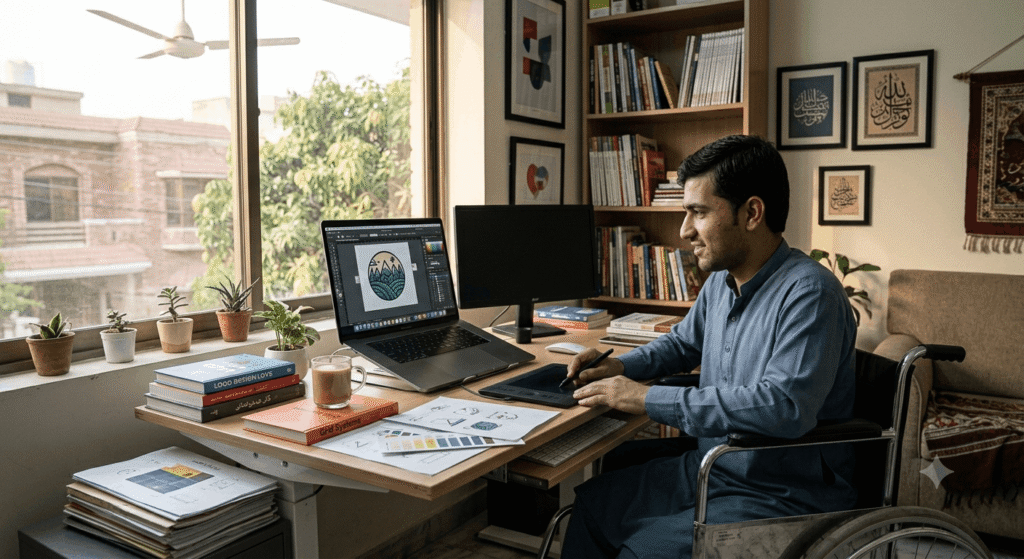
The answer was mixed. Some programs existed only on paper, hard to access in practice. Others turned out to be genuinely useful. Three years on, the outcome: registration with NADRA as a person with disability, a monthly stipend through the Punjab Social Welfare Department, two completed NAVTTC courses in computer applications and graphic design at an accessible training center, and a small freelance graphic design business run from home.
None of it happened easily or automatically. But the path exists. This guide maps it out, step by step.
The Registration Foundation: CNIC and Disability Certificate
Everything else builds on two foundational documents. If you don’t have these, the programs described below are largely inaccessible.
1. NADRA CNIC — The Baseline
Every program requires your CNIC. If you’re a person with disability and don’t yet have a CNIC — or your CNIC is expired — this is the absolute first step.
NADRA has made some provisions for persons with disabilities:
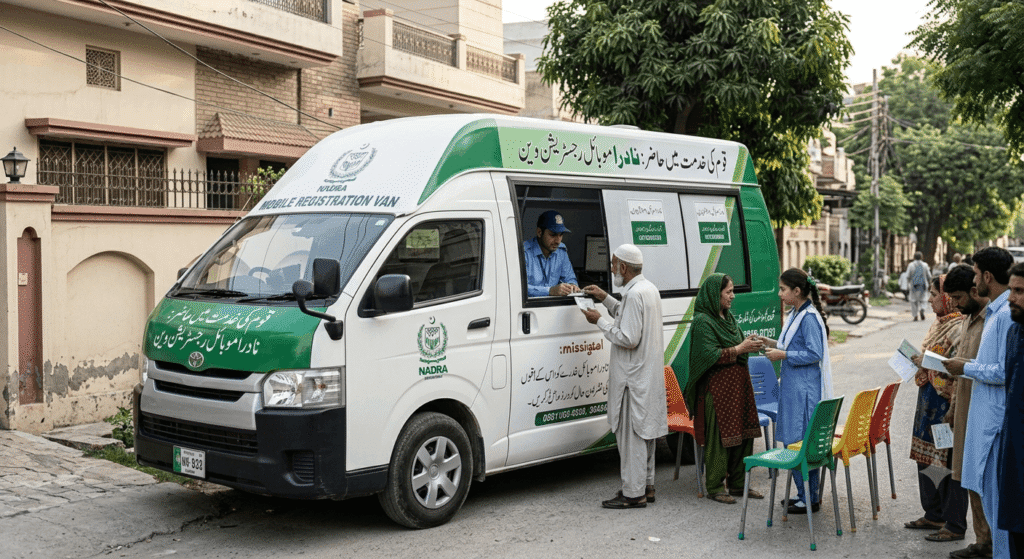
- Mobile registration vans in some areas that come to a location if a person cannot travel to a NADRA office
- Priority counters at NADRA offices for persons with disabilities, senior citizens, and women
- Home visit registration through NADRA’s disability accommodation process — call the NADRA helpline (0800-23232) and specifically ask about registration assistance for a person who cannot physically come to an office
The CNIC process is the same as for any citizen — just ensure you access the appropriate support to complete it.
2. Disability Certificate from the Social Welfare Department
This is the document that unlocks most disability-specific programs. It’s issued by the Provincial Social Welfare Department (through district Social Welfare offices) after a medical assessment confirms the nature and severity of the disability.
Types of disabilities covered:
- Physical disability (mobility impairment)
- Visual impairment (partial or total blindness)
- Hearing impairment (partial or total deafness)
- Intellectual disability
- Multiple disabilities
How to get the disability certificate:
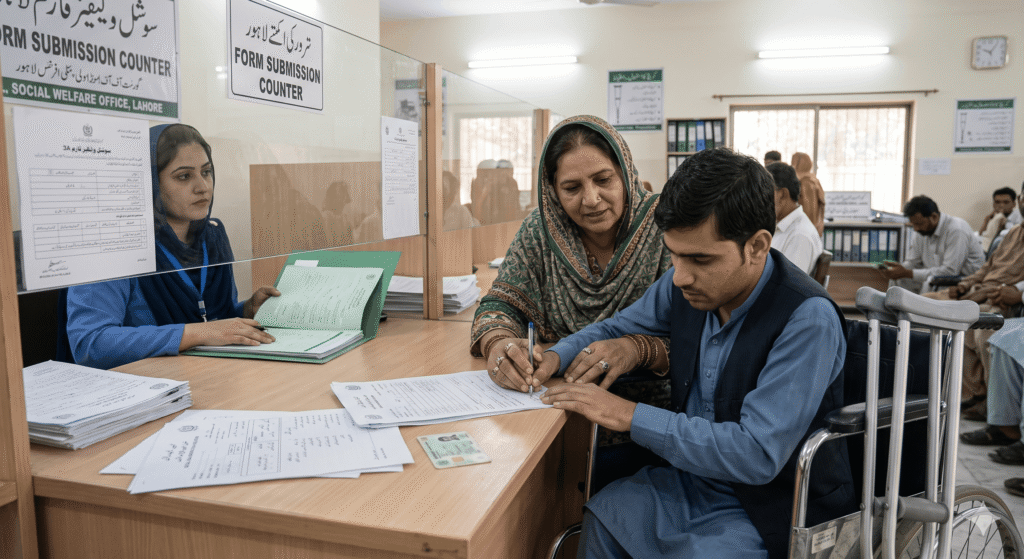
- Visit your District Social Welfare Office (in every district headquarters)
- Ask for the disability certificate application form
- Fill in the form with your CNIC details and a description of your disability
- Submit with: CNIC copy, recent photograph, medical documentation from a recognized hospital or specialist (doctor’s certificate describing the disability)
- The office schedules a medical examination through a government medical board
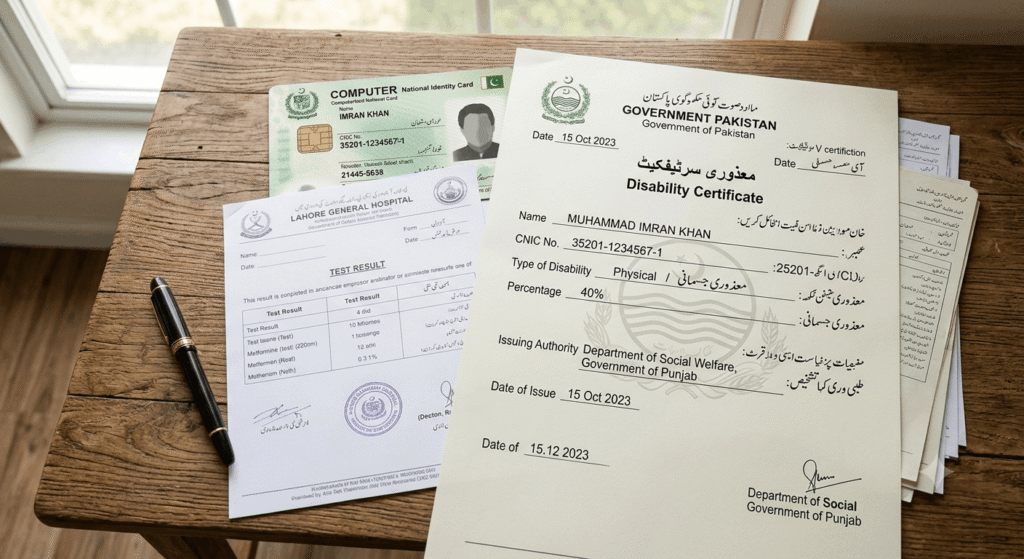
- After assessment, the certificate is issued specifying the type and percentage of disability
The certificate typically states disability as a percentage — e.g., “60% physical disability, permanently wheelchair-dependent.” This percentage matters for some programs that have minimum disability thresholds.
Time to obtain: 3 to 8 weeks typically, depending on the district’s medical board schedule.
Khalid’s certificate took 6 weeks. The most time-consuming part was getting an appointment with the government medical board. His neurologist’s private medical report helped establish the severity clearly.
Cash Support Programs for Persons with Disabilities
Punjab Social Welfare Department — Disability Allowance
The Punjab Social Welfare Department administers a monthly disability allowance for registered persons with disabilities in Punjab who are below the poverty threshold.
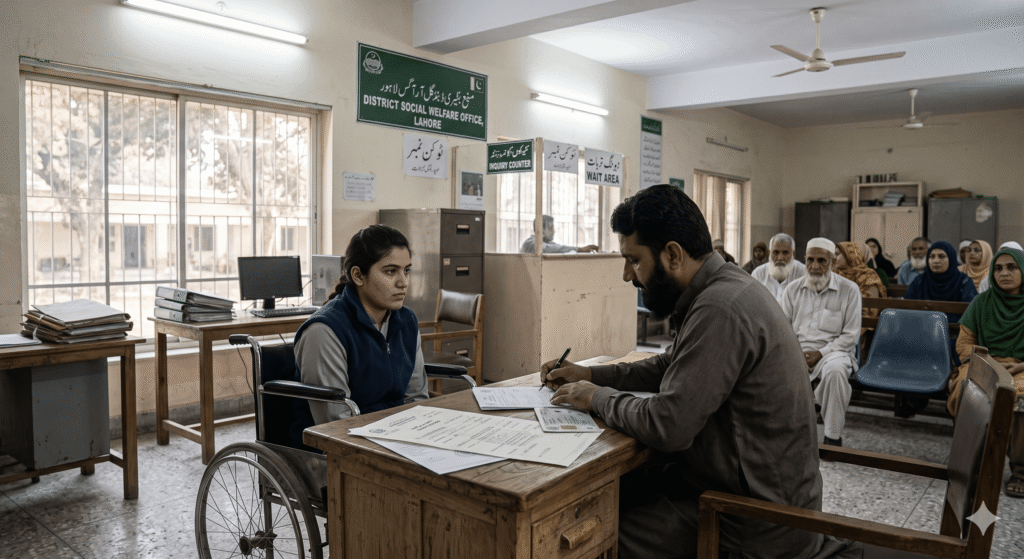
Current allowance: Approximately Rs. 2,000 to Rs. 3,000 per month (amount revised periodically — verify current figure at your district Social Welfare office).
Eligibility:
- Punjab domicile
- Valid disability certificate
- Below the poverty line (income assessment)
- Not employed in formal government service
How to apply:
- Visit the District Social Welfare Office
- Bring: CNIC, disability certificate, proof of residence, income documentation (or income affidavit)
- Fill in the disability allowance registration form
- The office reviews and registers eligible applicants
Payments are typically made monthly or quarterly through the applicant’s bank account or designated payment center.
Other provinces have similar programs — Sindh’s Social Welfare Department, KPK’s Social Welfare and Women Development Department, Balochistan’s Social Welfare Department. The structure is similar: disability certificate + income verification + district office registration. Contact your district’s Social Welfare office for province-specific details.
BISP Kafaalat — Priority Access for Disability-Affected Households
While BISP Kafaalat is a general poverty program (not disability-specific), households with a person with disability tend to have lower PMT scores because disability affects household income capacity. This means many disabled individuals or their families qualify for BISP.
Additionally, if the person with disability is a woman who is the household’s primary resident, she can be the registered BISP beneficiary in her own right.
Check your eligibility via 8171 SMS if you’re a disability-affected household not yet registered in BISP. The Dynamic Survey process (visit BISP Tehsil Office) can capture disability status in the household data.
Pakistan Bait ul Mal — Emergency and Ongoing Assistance
Pakistan Bait ul Mal (pbm.gov.pk) provides assistance to extremely poor and deserving citizens, with persons with disabilities as an explicit priority category. PBM can provide:
- Monthly or irregular financial assistance
- Medical treatment support
- Support for assistive devices (wheelchair, hearing aid, crutches)
Visit the District Bait ul Mal office with your CNIC, disability certificate, and documentation of need. PBM’s district committees assess and approve assistance.
Zakat Department — Disabled Persons as Priority Recipients
Under Islamic zakat law, persons with disabilities are among the recognized asnaf (categories of recipients). The formal government Zakat system provides monthly guzara allowance to registered mustahiq individuals, and disability is an explicit priority factor.
Visit your Local Zakat Committee or District Zakat and Ushr Department with CNIC, disability certificate, and evidence of financial need to register as a mustahiq recipient.
Employment and Livelihood Programs
2% Employment Quota in Government Jobs
The Disabled Persons (Employment and Rehabilitation) Ordinance 1981 mandates that 2% of government and private sector positions (for organizations above a certain size) must be reserved for persons with disabilities.
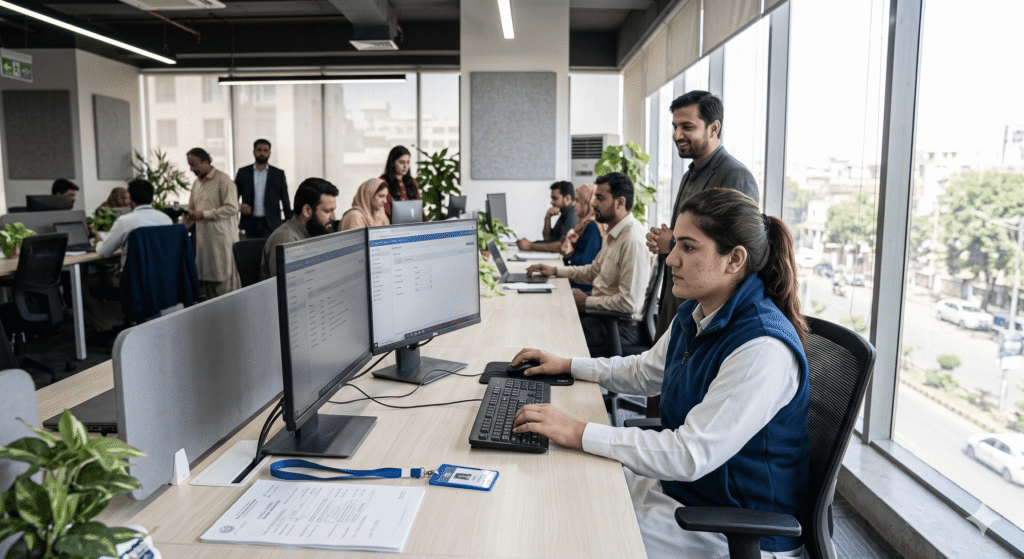
This quota is enforced with varying degrees of consistency, but it does exist in law and in government hiring policy.
How to access it in practice:
- When applying for government positions through FPSC (Federal Public Service Commission) at fpsc.gov.pk or Provincial Public Service Commissions, indicate your disability status during registration
- Apply for the “disability quota” category where it’s listed as a separate category in government job advertisements
- Ask the advertising department directly whether a disability quota category exists for a specific position
The National Job Portal (rozgaar.gov.pk or provincial equivalents) sometimes lists disability-quota positions separately. Check the filter options when searching.
NAVTTC Free Skills Training — With Accessibility Considerations
NAVTTC (navttc.gov.pk) offers free vocational training and specifically maintains provisions for persons with disabilities in some training centers — including accessible facilities and adapted curricula for certain disabilities.
When applying for NAVTTC courses:
- Specify your disability and accommodation needs during the application
- Ask the training institute specifically whether they have accessible facilities before committing to a center
- Request adaptive equipment or adjusted assessment formats if needed
Khalid attended a NAVTTC Computer Applications course at a center he specifically called in advance to confirm accessibility. The center had ground-floor classrooms and wheelchair access. He completed both courses with full attendance.
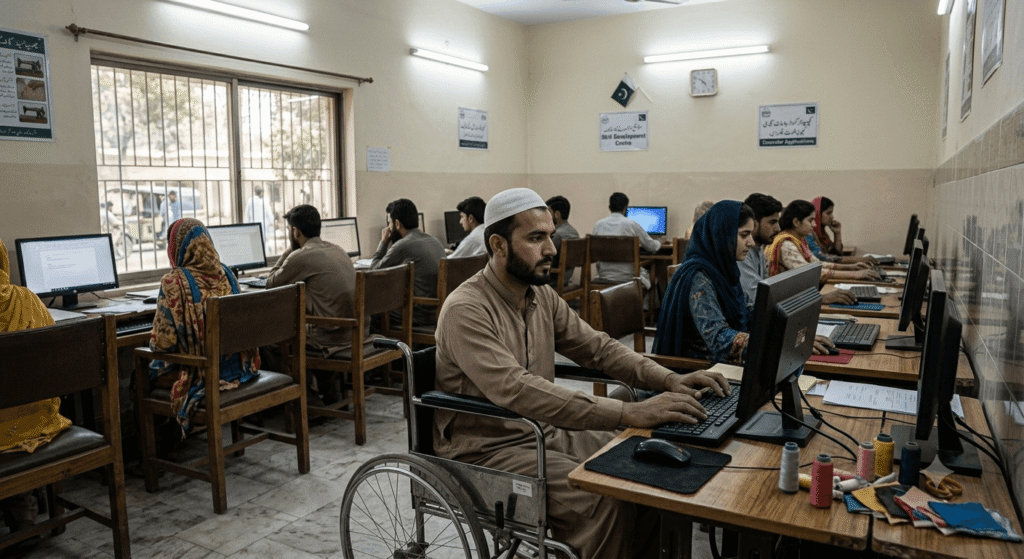
PSDF (Punjab Skills Development Fund) similarly has disability provisions in some programs. Check psdf.org.pk and specify your disability when applying.
PM Youth Loan Scheme — Disability Quota
The PM Youth Business Loan (pmkamyabjawan.gov.pk) has a dedicated quota for persons with disabilities within its overall allocation. The application process is the same as the standard program (online portal, bank verification) but applicants with a valid disability certificate are assessed in a separate category, improving selection odds.
For Khalid’s freelance design work, this scheme was something we looked at. His age (37 at the time) fell within eligibility. He ultimately went with Akhuwat’s zero-markup option for a smaller amount, but the PM Youth Loan remains an option for larger business capital needs.
Akhuwat — Interest-Free Loans for Persons with Disabilities
Akhuwat Foundation provides interest-free loans to persons with disabilities through their standard and women’s program tracks. Disability status is considered in the needs assessment.
For someone with a disability wanting to start a home-based business — computer work, tailoring, phone repair, tutoring — an Akhuwat loan (akhuwat.org.pk) for equipment and startup costs is one of the most accessible financing routes available.
Community guarantors replace collateral. Disability certificates strengthen the need assessment.
Education and Scholarship Support
Special Education Institutions
The Directorate of Special Education under provincial education departments operates special education schools and resource rooms for children with disabilities. These institutions provide:
- Free education
- Specialized teaching adapted to disability type
- Assistive learning materials
For families with disabled children, the Special Education Directorate in your province is the starting point. In Punjab: the Provincial Special Education Department (pse.punjab.gov.pk). Other provinces have equivalent directorates.
PEEF Disability Scholarships
The Punjab Educational Endowment Fund (PEEF) has dedicated scholarship support for students with disabilities pursuing higher education. Check peef.punjab.gov.pk during application windows.
HEC Need-Based Scholarship
The HEC Need-Based Scholarship (applied through your university’s financial aid office) is available to students with disabilities — disability directly affects household income and thus the need assessment. Disability certificates strengthen the application significantly.
Pakistan Bait ul Mal — Education for Disabled Children
PBM has specific programs supporting education for disabled children and their families. The District Bait ul Mal office is the application point.
Assistive Devices and Medical Support
Social Welfare Department — Assistive Device Provision
Most provincial Social Welfare Departments have programs providing free or subsidized assistive devices — wheelchairs, crutches, hearing aids, white canes — to registered persons with disabilities below the poverty line.
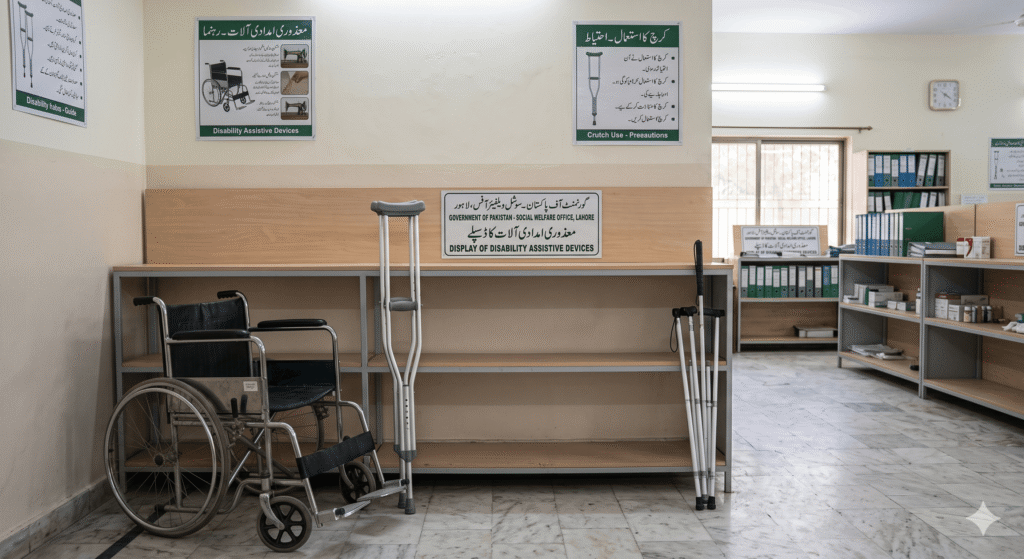
This is applied for at the District Social Welfare Office alongside or after disability certificate issuance. The District Medical Board often assesses device needs at the same time as the disability assessment.
Sehat Sahulat Card — Health Insurance for All
The Sehat Sahulat Program (health card) provides up to Rs. 1 million per family per year in cashless hospital treatment at empanelled hospitals. Persons with disabilities who are registered as beneficiaries can use this for disability-related treatments, surgeries, and hospitalization.
Check your Sehat Sahulat eligibility at your district health office or via sehat.gov.pk. BISP beneficiaries and Ehsaas-registered households are typically enrolled automatically.
Step-by-Step Registration Path
For someone starting from scratch:
Week 1-2:
- If CNIC not held: contact NADRA for mobile/home registration support (0800-23232)
- Gather medical documentation from your doctor or specialist
Week 3-4:
- Visit District Social Welfare Office
- Apply for disability certificate
- Ask about disability allowance registration at the same visit
Month 2:
- Medical board assessment for disability certificate
- Visit BISP Tehsil Office, check status via 8171, request Dynamic Survey if not registered
Month 3:
- Disability certificate received
- Submit disability allowance application (if eligible)
- Visit Local Zakat Committee for guzara allowance registration
- Visit District PBM office for emergency assistance if needed
Month 4 onwards:
- Apply for employment quota positions if interested in government work
- Apply for NAVTTC training (accessible center confirmed in advance)
- Explore PM Youth Loan or Akhuwat for business financing if self-employment is the goal
Common Mistakes That Block Access
Not getting the disability certificate first. Almost every disability-specific program requires it. Starting applications without it means being turned away from multiple offices. Disability certificate first, everything else after.
Going to offices without medical documentation. The District Social Welfare Office will ask for a doctor’s report describing your disability. A hospital discharge summary, specialist’s letter, or rehabilitation report — have at least one before your first office visit.
Not specifying disability status when applying for general programs. NAVTTC, PM Youth Loan, government job applications — these have disability provisions that only activate when you declare your status and provide the certificate. Not mentioning it puts you in the general pool without the quota benefit.
Assuming equipment isn’t covered. Many families with disabled members have bought wheelchairs, hearing aids, or crutches at full cost without knowing the Social Welfare Department or PBM might have covered them. Ask specifically about assistive device programs at your district office.
Giving up after inaccessible offices. Some government offices are not physically accessible. This is a real barrier. But many disability programs can be initiated through a family representative or through a phone call in cases where the person cannot physically attend. Ask explicitly: “Can my family member apply on my behalf?” or “Is there a home visit option?”
Quick Reference
| Program | Support Type | Where to Apply |
|---|---|---|
| Disability Certificate | Essential document | District Social Welfare Office |
| Punjab Disability Allowance | Monthly cash | District Social Welfare Office |
| BISP Kafaalat | Quarterly cash | BISP Tehsil Office / 8171 |
| Pakistan Bait ul Mal | Emergency cash + devices | District PBM Office |
| Zakat Guzara | Monthly cash | Local Zakat Committee |
| Government Job Quota (2%) | Employment | FPSC / Provincial PSC |
| NAVTTC Training | Free skills | navttc.gov.pk |
| PM Youth Loan (disability quota) | Business loan | pmkamyabjawan.gov.pk |
| Akhuwat Interest-Free Loan | Business loan | akhuwat.org.pk |
| PEEF Scholarship | Education | peef.punjab.gov.pk |
| Sehat Sahulat | Health insurance | sehat.gov.pk |
| Assistive Devices | Wheelchair, hearing aid, etc. | District Social Welfare Office |
Khalid once told me that the hardest part of his situation wasn’t the physical limitations — he’d adjusted to those. The hardest part was feeling invisible to systems that existed supposedly to support him.
The programs in this guide don’t make the physical challenges disappear. But they do acknowledge that those challenges exist and affect economic participation, and they provide real resources in response.
The path to accessing them is slower and more document-heavy than it should be. Some offices are inaccessible. Some staff are unhelpful. Some programs are underfinanced.
But the path exists. Khalid is on it. Other people with disabilities in Pakistan deserve to know it exists too.
Need to apply for disability benefits, financial assistance, a disability certificate, or other government support? Visit the official Social Welfare portal below to check eligibility, complete your registration, and access the latest disability support programs.
Apply for Disability Support OfficialAre you a person with disability or caring for someone who is, and need help figuring out which specific programs apply to your situation or province? Leave a comment with your details and we’ll try to help.