

A merit-based admission letter to a BS Software Engineering program at a well-regarded Islamabad university doesn’t automatically mean the seat gets used. For one student from Mianwali, the acceptance came first — the deferral came four months later, once the actual cost was worked out.
Rs. 35,000 per semester in fees. Add hostel, transport, books, and basic living expenses, and the real per-semester cost lands closer to Rs. 80,000-100,000 — somewhere between Rs. 640,000 and Rs. 800,000 across four years. Against a schoolteacher father’s Rs. 42,000 monthly salary, with two younger siblings’ school fees and household bills already accounted for, there was Rs. 5,000-8,000 left over most months. Nowhere close.
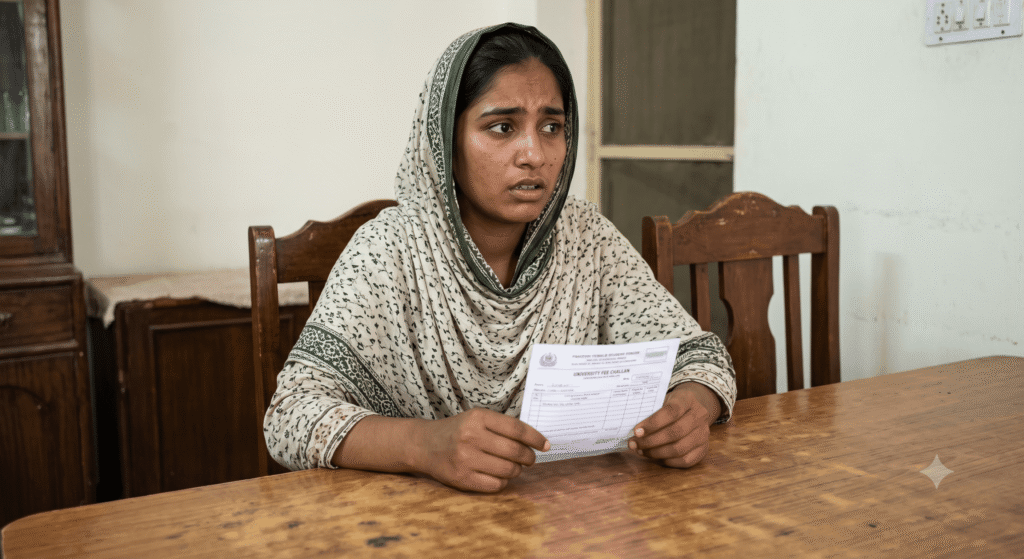
The admission was deferred for a year while the family tried to figure out an alternative that never fully materialized on its own.
The HEC Need-Based Scholarship and the government’s student loan programs turned out to be that alternative — options a family friend mentioned almost as an afterthought, and that neither parent had known to look for.
The student is now in her second year, with the loan covering tuition and part of living expenses, repayable only after graduation and only once she’s earning.
This guide covers exactly that path — the scholarship, the loan programs, and how the deferral could have been avoided with the right information at admission time.
The Landscape of Student Loans in Pakistan
Before jumping into applications, it’s worth understanding that
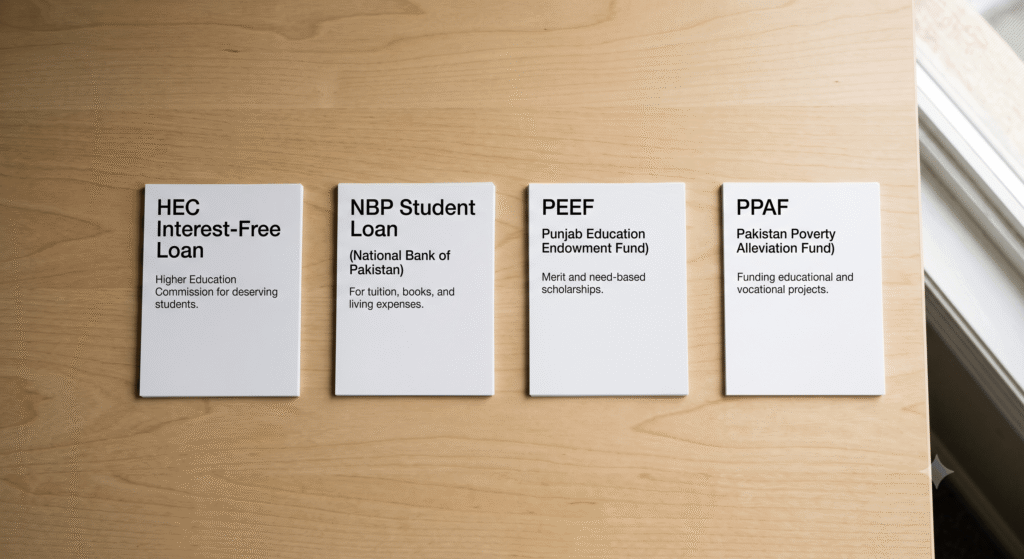
“student loans in Pakistan” isn’t one scheme — it’s several different programs running in parallel, managed by different bodies, with different eligibility criteria and different terms.
Getting confused about which one you’re applying for is the most common mistake, and it happens constantly.
Here are the main options currently operating:
1. HEC Interest-Free Loan Scheme
The Higher Education Commission (HEC) runs an interest-free loan program for students enrolled in HEC-recognized universities. This is the most widely known student financing program and the one most people mean when they say “government student loan.”
Key features:

- Interest-free — no markup, no profit rate, just the principal amount returned after graduation
- Covers tuition fees — disbursed directly to the university in most cases
- Available to Pakistani students enrolled in HEC-recognized institutions
- Repayment begins after graduation — typically with a grace period of 6 to 12 months after degree completion
- Loan amounts tied to actual tuition — the loan pays what your institution charges, within defined limits
This is what Sara applied for and received. The absence of interest/markup is what makes it significantly more accessible than any commercial financing.
2. National Bank of Pakistan (NBP) Student Loan Scheme
NBP runs a separate student loan facility — sometimes called the NBP Student Loan Scheme or Education Finance facility. This is a commercial bank product with government backing, offering loans at subsidized (not zero) markup rates.
Key features:
- Available for both tuition and living expenses in some packages
- Markup rate is subsidized compared to personal loan rates — typically around 5–8% per annum
- Repayment begins after graduation with a grace period
- Available at NBP branches nationwide
3. Punjab Educational Endowment Fund (PEEF)
For students specifically in Punjab, PEEF provides scholarships and interest-free loans to students from low-income backgrounds. While primarily a scholarship program, PEEF also offers loan support for students who don’t meet scholarship cutoffs but still demonstrate financial need.
4. Pakistan Poverty Alleviation Fund (PPAF) and Microfinance-Linked Education Support
Some microfinance institutions operating under PPAF provide education financing to families from low-income backgrounds. Less formal, smaller amounts, but available in areas where HEC or NBP programs may have less reach.
For the purpose of this guide, we’ll focus primarily on the HEC Interest-Free Loan as it’s the most impactful and most directly government-administered.
Who Is Eligible for the HEC Interest-Free Loan
The student must:
- Be enrolled in a full-time undergraduate or postgraduate program at an HEC-recognized institution
- Be a Pakistani national
- Demonstrate financial need — this is assessed through family income documentation and is the central qualifying criterion
- Have no history of academic misconduct (expulsion, academic fraud, etc.)
- Not be receiving another full scholarship that already covers tuition
Financial need criteria: The HEC uses a need assessment framework. Generally, households with monthly income below Rs. 45,000 to Rs. 60,000 are prioritized (exact thresholds vary by year and program phase). Larger families with multiple dependents get more favorable assessments.
What doesn’t disqualify you:
- Attending a private university (some HEC-recognized private institutions are included)
- Being a part-time worker to support yourself
- Coming from a small city or rural area (these actually get priority consideration)
What does disqualify you:
- Attending an institution not recognized by HEC
- Having already received a full-fee scholarship
- Academic standing below the required minimum GPA (usually 2.0 on a 4.0 scale)
- Submitting fraudulent income documentation
Step-by-Step: How Sara Applied
Step 1: Confirm Your Institution Is Registered with HEC
Not every university that calls itself a university is HEC-recognized. Before anything else, go to hec.gov.pk and check the institution list under “University Rankings” or “Recognized Universities.”
Sara’s university was on the list. That cleared the first hurdle.
Step 2: Go to Your University’s Financial Aid Office
The HEC loan program is administered through your institution — not through a bank or a separate government office.
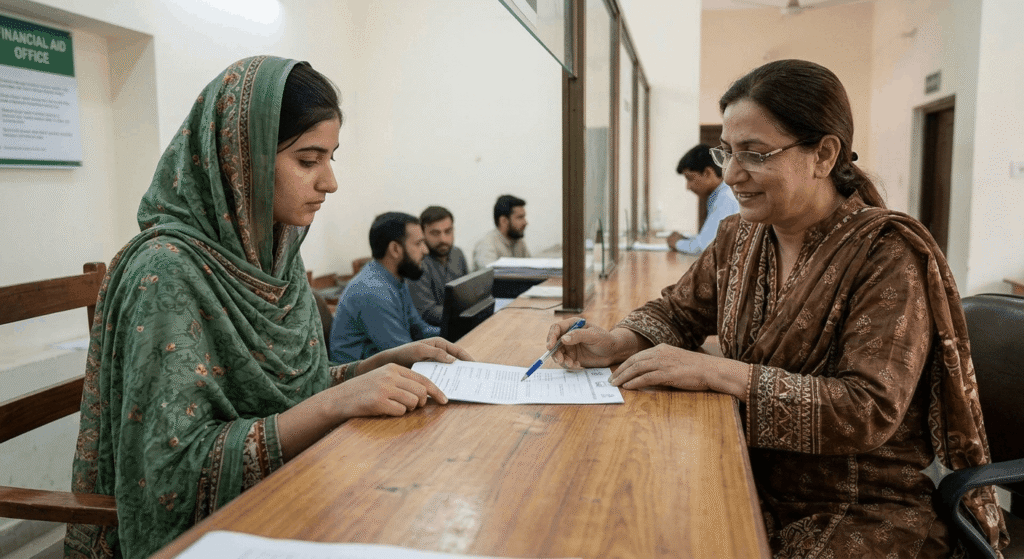
Your first stop is your own university’s financial aid or student affairs office.
Ask specifically:
- Does this institution participate in the HEC Need-Based Loan Scheme?
- Is the current semester’s application window open?
- What documents do I need to apply?
Some institutions have a financial aid office with dedicated staff. Others have a single admin office that handles everything. In smaller universities, the relevant person may be the Dean of Student Affairs.
Sara’s university had an active financial aid office. The officer there was familiar with the HEC scheme and gave her a checklist on the spot.
Step 3: Gather Your Documents
The exact list varies slightly by institution, but standard requirements include:
- Student’s CNIC or B-Form (if under 18)
- University admission letter and fee voucher — showing your enrollment status and what you owe
- Father’s/guardian’s CNIC
- Proof of family income:
- Salaried: salary slips for last 3 months + employer certificate
- Self-employed: bank statements for last 6 months + affidavit of income
- Government employee: last pay slip + service certificate
- Utility bills — showing the family’s residential address
- Death certificate (if father is deceased and mother is the head of household)
- Academic transcripts (for continuing students) or intermediate result (for first-year applicants)
- Photographs (typically 2–4 passport-sized)
- Income affidavit — a sworn statement about household income, signed before a notary or First Class Magistrate
The income affidavit is the document that causes the most confusion and delay. It’s not something you have lying around — you need to get it made specifically for this application. A notary in your city can do this for Rs. 300 to Rs. 500. Take your father’s (or guardian’s) CNIC and go in person.
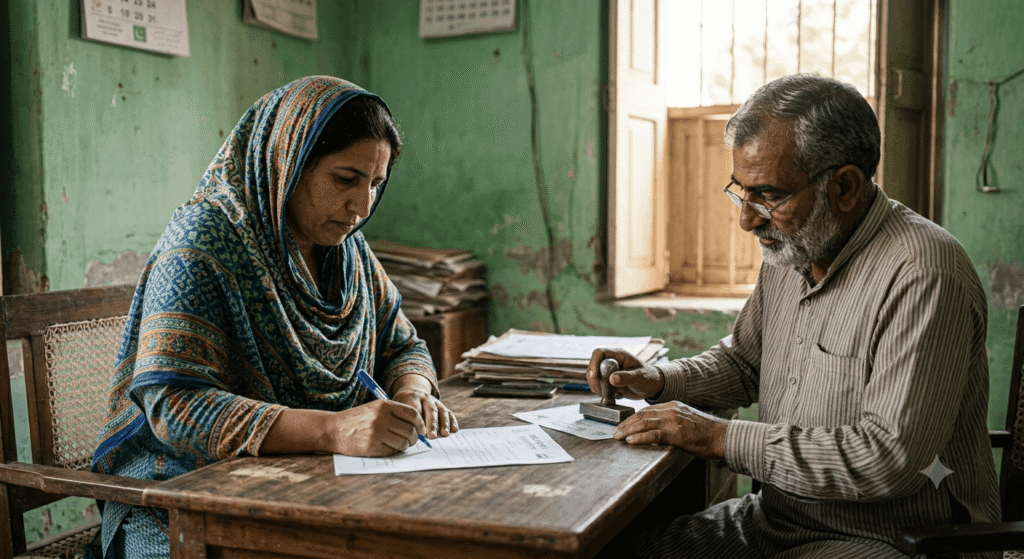
Sara’s mother had to go to a notary in Mianwali and get the affidavit done before mailing the documents to Sara in Islamabad. This took four days, which nearly missed the application deadline.
Lesson: Start the affidavit process the moment you know you’re applying. Don’t wait until you have everything else.
Step 4: Submit the Application Through the University
The completed application — with all supporting documents — is submitted to your university’s financial aid office. They compile all applications from their students and submit them to HEC collectively.
This means your application’s fate partly depends on your university’s admin being efficient. If you submit early and they submit late, you may miss the HEC processing window.
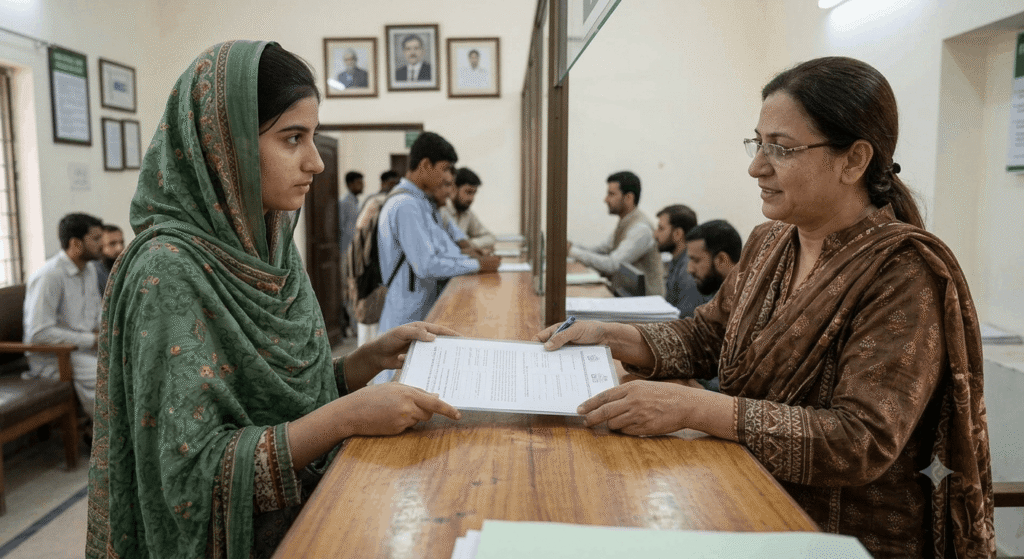
Follow up with your financial aid office after submission to confirm they’ve received your application, and ask when they plan to submit the batch to HEC.
Step 5: HEC Review and Approval
HEC reviews the applications sent by institutions, runs need assessments, and allocates loan amounts based on financial need, available budget, and the number of applicants in that cycle.
This process takes 6 to 12 weeks. It’s not fast. Apply early in the semester, not the week before fees are due.
If approved, HEC communicates the approved amount to the university, and the university credits the loan to your student account — effectively reducing your outstanding fee balance.
For living expenses (in schemes that include them), amounts may be disbursed to the student’s personal bank account in monthly installments.
Sara’s tuition loan was approved at 100% of her semester fee for the first semester, dropping to 75% in subsequent semesters as HEC recalibrated its budget allocations.
Step 6: Repayment After Graduation
This is the part students often don’t think about carefully enough when applying — but they should.
The HEC interest-free loan must be repaid after graduation. The standard arrangement:
- Repayment begins 6 to 12 months after graduation (grace period)
- Repayment tenure typically 5 to 10 years
- Monthly installments calculated based on total loan amount and tenure

- No interest — you repay exactly what was disbursed
If you borrowed Rs. 280,000 over four years, you repay Rs. 280,000 over whatever tenure is agreed. No markup. No compound interest. Just the principal.
This is genuinely one of the most borrower-friendly loan structures available in Pakistan for any purpose.
What happens if you don’t repay: Non-repayment is taken seriously. HEC has mechanisms to pursue recovery, and defaulting on an education loan affects your credit history and may affect future government scheme eligibility. Take the repayment obligation seriously before you sign.
The NBP Student Loan — When It Makes Sense
The NBP Student Loan is worth considering when:
- Your institution isn’t included in the HEC scheme
- You need financing for living expenses beyond just tuition
- You’ve already used the HEC loan but have additional needs
The markup rate (5–8%) is higher than the HEC zero-markup, but far lower than personal loan rates. Apply at any NBP branch — the process is more bank-like (account opening, income verification, credit check) but follows similar documentation requirements.
For Sara, the HEC loan covered tuition. NBP’s education finance facility was something she looked at for supplemental hostel costs, though she ultimately managed without it through part-time work.
Common Mistakes That Derail Student Loan Applications
Applying too late. Loan processing takes 6 to 12 weeks. If you apply the week before fee payment is due, you will pay the fee out of pocket and wait for reimbursement — or miss the semester’s payment deadline. Apply at the start of each semester, not the end.
Income documentation that doesn’t match reality. HEC’s need assessment is based on what you submit. If your father earns Rs. 42,000 but the salary slip submitted shows Rs. 38,000 (a slightly old one), fine. If it shows Rs. 65,000 (from a period of overtime), that may push you above the threshold. Submit current, representative documentation.
Forgetting the income affidavit. Every year, students submit perfect applications missing only this one document. The affidavit is not optional. It’s the sworn legal declaration of household income. Get it done first.
Not telling the university financial aid office you applied. Some students submit documents and assume the office knows what to do with them. Follow up actively. Ask whether your file is complete, when the batch is being submitted to HEC, and who to contact if there’s a problem.
Attending a non-HEC-recognized institution. This is heartbreaking when it happens — a student spends a semester at a small private college that wasn’t on the HEC list and only discovers this when trying to apply for the loan. Always verify before enrollment.
Misunderstanding “scholarship” vs. “loan.” Some students apply for the HEC Need-Based Scholarship (a grant — doesn’t require repayment) and confuse it with the Need-Based Loan. Both are offered through HEC. Both help. But one needs to be paid back. Know which one you’re applying for.
A Realistic Picture of the Process
Sara’s first semester loan application was submitted in September. The money hit her university account in December. She’d had to pay the fee in September using money borrowed from a relative, which the loan reimbursement then repaid.
By second year, she knew to apply in August for the September semester — giving HEC enough time to process before her fees were due.
Her total loan across four years will be approximately Rs. 280,000 in tuition support. She’ll begin repaying roughly 18 months after graduation, in monthly installments that her software engineering salary will comfortably cover.

She told me recently that if nobody had told her about this scheme, she would have skipped university entirely. That’s not an exaggeration — that was the actual alternative.
The scheme isn’t perfect and it isn’t instant. But for a student from a genuinely low-income family with real academic ability, it’s one of the most valuable government programs running in Pakistan right now.
Quick Reference
| Scheme | Interest | Who Applies | Covers | Repayment |
|---|---|---|---|---|
| HEC Interest-Free Loan | 0% | Through university | Tuition | After graduation, 5–10 years |
| NBP Student Loan | 5–8% p.a. | At NBP branch | Tuition + living | After graduation |
| PEEF (Punjab students) | 0% (loan component) | Through PEEF office | Tuition | After graduation |
Need financial support to continue your education? Visit the official Student Loan Scheme portal below to review the eligibility criteria, download the application form, and apply for an interest-free student loan through the Government of Pakistan.
Apply for Student Loan Scheme OfficialHave questions about whether your university is eligible, what documents are needed in your specific situation, or how the repayment works? Leave a comment and we’ll try to help.