

Being eligible for the HEC Need-Based Scholarship and actually being selected for it are two different things — a distinction most guides skip entirely, and one that cost one applicant two rejected applications before it clicked.

Her family’s income was below the threshold both times. Eligibility was never the problem. What got her rejected was how the case was presented — which documents were submitted, and how clearly the household’s financial situation was actually demonstrated on paper.
The third application succeeded, with full fee coverage for the rest of the BS program. Nothing about the family’s income had changed between attempt two and attempt three. What changed was the completeness and clarity of the financial documentation — specific proofs that hadn’t been included the first two times.
That’s the real gap in how need-based scholarships work: eligibility means a person could qualify. Selection depends entirely on how thoroughly and credibly that need gets demonstrated in the application itself.
This guide covers exactly that — what selection committees actually look for, how financial need gets assessed, and how to build an application that reflects the real situation instead of one that sells it short through incomplete documentation.
What “Need-Based” Actually Means
A need-based scholarship is specifically about financial circumstances, not academic performance. That doesn’t mean academic standing doesn’t matter at all — there’s usually a minimum GPA or grade requirement to stay eligible — but the primary selection criterion is whether your family genuinely cannot afford the cost of education without support.
This is different from a merit scholarship, where the highest performers get funded regardless of income.
It’s also different from a merit-cum-need scholarship, where you need both a strong academic record AND demonstrated financial need.
Most of the major government programs in Pakistan — HEC Need-Based Scholarship, PEEF, Ehsaas Undergraduate — are primarily need-based with a minimum academic floor. If your family income is below the threshold and you’re passing your courses, you’re in the running. What determines whether you get selected over another eligible student is largely how well-documented and how clearly presented your need is.
How Financial Need Is Assessed in Pakistan’s Scholarship Programs
Understanding the assessment process changes how you prepare.

Household income is the starting point. Most programs define an income ceiling — families earning above X per month don’t qualify, families below X do. This figure varies by program (typically Rs. 30,000 to Rs. 60,000 per month in 2026, depending on the scheme) and sometimes adjusts for household size.
Income documentation has to match. The figure you state has to be backed by documentation. A salary slip, bank statements, or an income affidavit. If there’s a mismatch — you claim Rs. 35,000/month but your bank statements show Rs. 60,000 in average monthly deposits — the application creates suspicion rather than trust.
Household size is considered. A family of 3 with Rs. 40,000/month income is in a very different position from a family of 8 with the same income. Good scholarship applications communicate household size clearly — number of dependents, number of school-going children, any family members with medical conditions.
Other financial obligations factor in. Rent payments, medical bills, other loans or obligations, support of elderly parents — these reduce effective household income available for education. Including these in your application narrative (with documentation where possible) gives the assessor a fuller picture.
Geographic context matters. Living in a major city with Rs. 40,000/month is different from the same income in a smaller town where costs are lower. Some programs account for this; others don’t. But describing your living context adds nuance to the income figure.
The income affidavit is the credibility anchor. For informal income — a father who runs a small business, a daily wage worker, anyone without a salary slip — the income affidavit (sworn statement before a notary or magistrate) is how the claim gets formalized. Without it, informal income is unverifiable and many programs simply can’t process it.
Step-by-Step: Building a Strong Need-Based Application
Step 1: Know the threshold before you apply.
Every need-based program publishes an income ceiling. Look it up before you invest time in the application. For HEC NBS, check hec.gov.pk. For PEEF, check peef.punjab.gov.pk. For Ehsaas undergraduate, your university’s financial aid office will have the current figures.
If your family’s documented income is close to the threshold — within 10–15% — apply anyway. Household size, additional expenses, and the overall picture can push the effective assessment below the cutoff even when the gross income number is borderline.
Step 2: Gather income documentation for every earning household member.
This is where Zainab went wrong in her first two applications. She submitted only her father’s salary slip and treated that as the complete picture.
What the assessor sees is incomplete without understanding the full household picture:
- Is the father the only earner?
- How many dependents does he support?
- Are there medical expenses?
- Are there younger siblings also in school?
- Is there rent being paid?
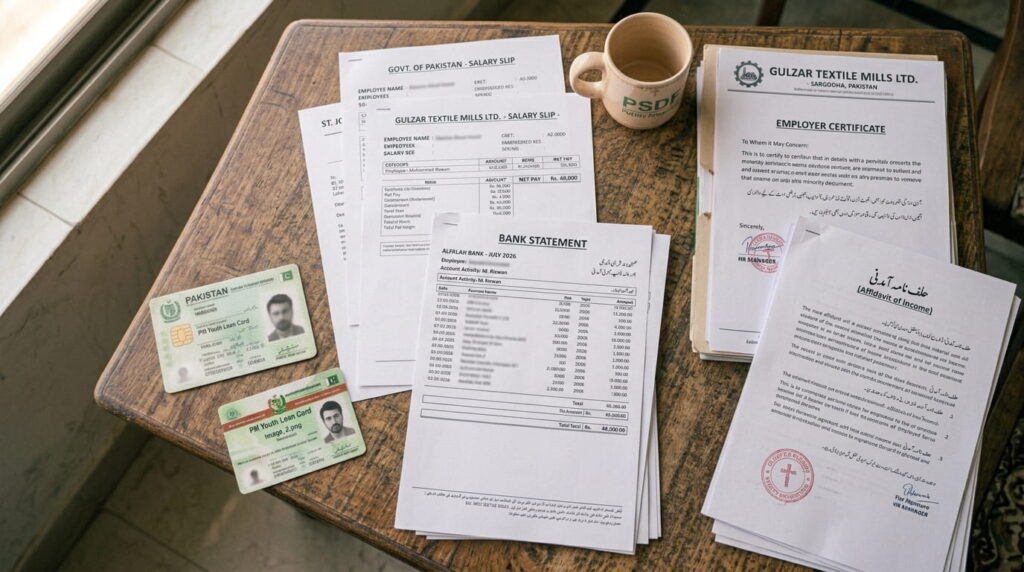
For each earning member of your household, gather:
Salaried employment:
- Last 3 months’ salary slips
- Employment certificate on employer’s letterhead
- Last 6 months’ bank statements
Self-employed / small business:
- Last 6 months’ bank statements
- Income affidavit specifying average monthly income
- Any business registration or NTN (strengthens the affidavit’s credibility)
Informal / daily wage:
- Income affidavit
- If possible, a letter from an employer or contractor confirming engagement and approximate daily/monthly income
No income / widow / disabled:
- Documentation of status (death certificate, disability certificate)
- Evidence of any government support received (BISP payment records, zakat)
Step 3: Document household expenses and obligations.
This is the step most students skip entirely — and it’s often what separates a borderline application that gets approved from one that doesn’t.
Gather:
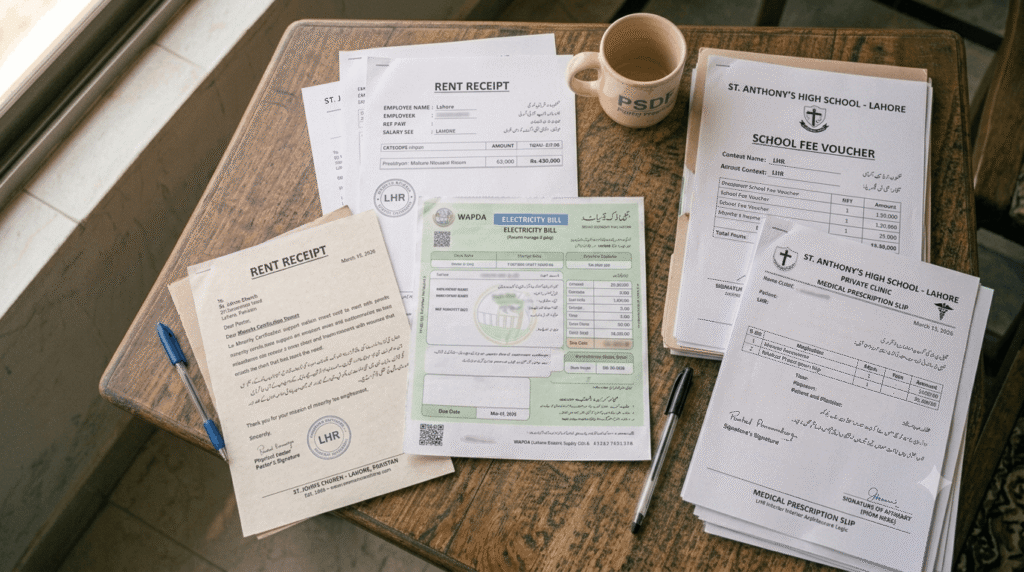
- Rent receipt or rental agreement — if your family pays rent, this directly reduces disposable income
- Utility bills — not just as address verification but as evidence of household scale
- School fee receipts for younger siblings — each sibling in school represents an educational expense the household is already bearing
- Medical bills — if a family member has a chronic condition or ongoing treatment, include recent bills or prescriptions
- Loan or obligation documentation — if the family has an existing microfinance loan, home loan installment, or other debt obligation, include the repayment schedule
None of these individually may change the assessment, but together they paint a picture of a household where Rs. 40,000/month doesn’t go as far as the number suggests.
Step 4: Write a clear, honest household narrative.
Many scholarship applications include a field for “statement of financial need” or allow a brief personal statement. Don’t waste this space with vague language like “my family is poor and cannot afford fees.”
Use it to tell a specific, factual story:

“My father earns Rs. 38,000/month as a security guard. We are a family of 6 — my parents, myself, and three younger siblings (ages 14, 11, and 8 — all in school). We rent our home in Lahore for Rs. 12,000/month. My youngest sibling has a recurring respiratory condition requiring monthly medication costing approximately Rs. 3,000. After fixed expenses, approximately Rs. 11,000 is available monthly for food, transport, and savings — leaving nothing for university fees without this scholarship.”
That paragraph is specific. It has numbers. It explains the gap. It names the competing expenses. An assessor reading that understands the financial reality without having to infer it from raw income figures.
Zainab’s third application included a version of this narrative. Her first two had not.
Step 5: Get the income affidavit done first — not last.
If any household member has informal income (which is true for most households in Pakistan to some degree), the income affidavit is non-optional.

It’s a sworn, signed statement of household income made before a notary public or First Class Magistrate.
Cost: Rs. 300–500 Time: 1–2 hours at a notary office, or a morning at a court if a magistrate is required What you need to bring: Parent’s/guardian’s CNIC, the approximate monthly income figure you’re declaring
Get this done before the application window opens, not during it. Many students scramble for the affidavit in the last week of the deadline and either get it wrong or miss the deadline.
Step 6: Cross-reference your documents for consistency.
This is the quality check that Zainab’s mentor walked her through before her third application.
Go through every document you’re submitting and check:
- Does the name on all documents match exactly (father’s name, student’s name)?
- Does the address on utility bills match the address on the application?
- Does the income figure in the affidavit match the income on bank statements (or at least not contradict it significantly)?
- Are all documents dated within the required recent window (usually last 3 months for income docs)?
Inconsistencies don’t automatically disqualify you, but they trigger closer scrutiny and sometimes requests for clarification that delay your application or move it to the back of the queue.
Step 7: Submit through the correct channel and follow up.
Most need-based scholarships in Pakistan are submitted through your university — even when HEC or PEEF is the funding body. Your university’s financial aid or student affairs office collects applications and submits them in a batch.
Submit early — not the day before the deadline. Early submissions have more time for follow-up if something is missing.
After submission, ask the financial aid office:
- Has my application been marked complete?
- When will the batch be submitted to HEC/PEEF?
- Who should I contact if I don’t hear back by [a reasonable date]?
Write down the name of the person you spoke to and the date. This paper trail helps enormously if there’s ever a dispute about submission status.
What Happened With Zainab — The Full Story
First application: submitted salary slip, enrollment certificate, a photograph. No income affidavit (her father works as a warehouse supervisor with a fixed salary — she thought the salary slip was enough). No household expense documentation. No narrative. Application returned as incomplete.
Second application: added the income affidavit, but it listed a figure that was slightly inconsistent with the salary slip she also submitted (her father had gotten a small raise between the documents). The discrepancy flagged her file for review. By the time the review was resolved, the batch had been submitted and her application wasn’t included.
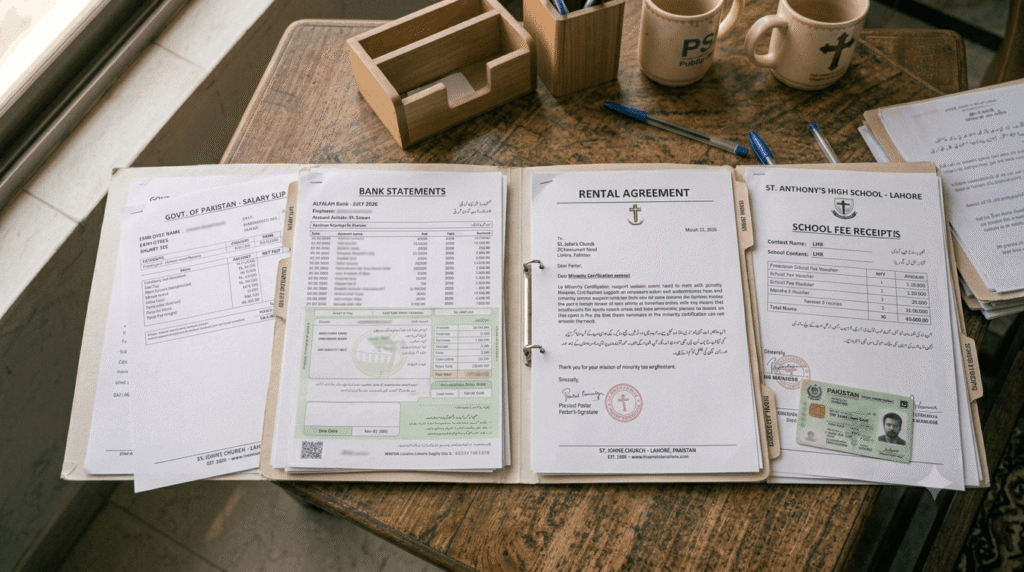
Third application: income affidavit matching the salary slip exactly. Three months of bank statements. Rental agreement (they rent in Gulberg). School fee receipts for two younger siblings. A brief but specific narrative paragraph explaining the household composition and competing expenses. Cross-referenced for consistency before submission. Submitted in the first week of the window.
Approved. Full fee waiver. Retroactive for the current semester.
She cried on the phone with her mother when she found out. Not because the scholarship was unexpected — she’d been told she was eligible the whole time. Because two years of effort had finally translated into the right outcome, and the difference had been presentation and documentation, not eligibility.
Common Mistakes That Get Need-Based Applications Rejected or Delayed
Submitting only salary slips without a bank statement. Salary slips can be fabricated or outdated. Bank statements are harder to manipulate and provide a 6-month view of actual cash flow. Submit both.
Forgetting the income affidavit for informal income. If even part of the household income is from self-employment, trading, farming, or daily wages — the affidavit is mandatory. Don’t assume it’s optional because someone in the household also has a salary slip.
Income figures that don’t add up. A salary slip showing Rs. 35,000/month combined with bank statements showing Rs. 55,000/month average deposits triggers questions. Explain income sources clearly. If there are multiple sources (salary + rent from a small property + remittances), list them all.
Not documenting competing household expenses. Your household income figure alone doesn’t tell the assessor what’s left after fixed obligations. Help them see it.
Applying once and waiting. Need-based scholarships renew annually or per semester in most programs. If you qualify in year one, reapply every cycle. Don’t assume the scholarship continues automatically — it usually doesn’t.
Assuming rejection means permanent ineligibility. Zainab was rejected twice before succeeding. Rejection is often about documentation, not eligibility. Find out why you were rejected, fix it, and reapply.
Quick Reference: Income Documentation by Source
| Income Source | Required Documentation |
|---|---|
| Salaried (private) | Salary slips (3 months) + employer certificate + bank statement |
| Salaried (government) | Last pay slip + service certificate + bank statement |
| Self-employed | Bank statements (6 months) + income affidavit + NTN if available |
| Daily wage | Income affidavit + employer/contractor letter |
| Farming | Income affidavit + land records if available |
| No income (widow/disabled) | Status certificate + BISP records if applicable |
| Remittances | Bank transfer records + income affidavit |
The need-based scholarship system in Pakistan is imperfect — processes are slow, windows are narrow, and documentation requirements can feel disproportionate for families who are already under financial pressure.
But it works when you work it properly. The funding exists. The programs are real. The selection process is looking for applicants who demonstrate their need clearly, not who need it most in some abstract sense.

Zainab’s third application didn’t succeed because her need was greater than before. It succeeded because it was finally visible.
Make your need visible. That’s the entire game.
If you’re facing financial challenges but want to continue your education, visit the official HEC Need-Based Scholarship portal below to learn about eligibility requirements and begin your scholarship application through the proper channel.
Apply for Need-Based Scholarship OfficialStuck on a specific document, not sure how to handle an inconsistency in your income records, or trying to figure out whether your family qualifies? Leave a comment with your situation and we’ll try to help you work through it.