

Private IT bootcamps in Pakistan routinely charge Rs. 50,000 to Rs. 150,000 for the same web development and freelancing skills that show up constantly in online course ads. For a student who’s just finished FSc with decent marks but no money for a four-year degree, that price tag closes the door before it opens.

That gap — between wanting to learn something useful and being able to afford the training — is exactly what leaves a lot of capable young people stuck teaching themselves in pieces off YouTube. Progress happens, but slowly, and without certification, structure, or any way to actually prove the skill to an employer, self-taught learning can feel like it’s going nowhere.
DigiSkills.pk was built to close that exact gap: free, online, government-backed courses with internationally recognized certifications, no registration fee.
One student completed two tracks — Freelancing and E-Commerce — over four months. Within six months of finishing, he had two regular clients on Fiverr and was earning Rs. 35,000-40,000 a month from home.
None of that is unusual once someone actually finds the program. The only real barrier is that most people never hear about it in time.
The Landscape of Government IT Training in Pakistan
There’s a surprising amount of free or heavily subsidized IT training available through government programs in Pakistan — the problem is that it’s scattered across different bodies, different portals, and different announcement channels. You have to know where to look.
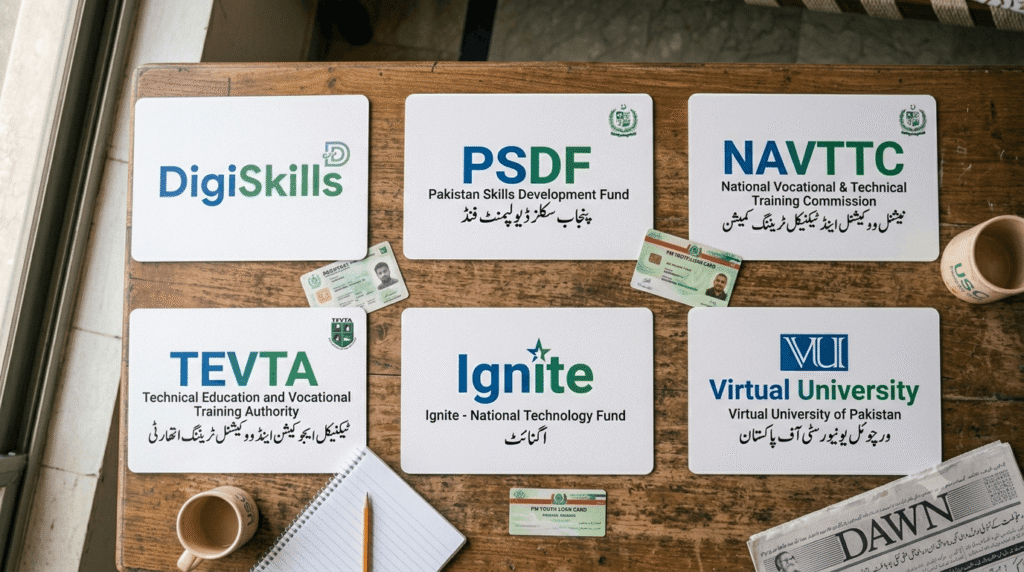
The main bodies running free IT training in 2026:
- DigiSkills.pk — Ministry of IT & Telecommunication
- PSDF (Punjab Skills Development Fund) — IT track courses in Punjab
- NAVTTC (National Vocational and Technical Training Commission) — federal, covers IT and tech trades
- TEVTA (Technical Education and Vocational Training Authority) — provincial, Punjab-focused
- Ignite (National Technology Fund) — advanced IT and startup support
- Virtual University of Pakistan — government university offering accredited programs, some free or subsidized
Each has different courses, different eligibility, different application processes, and different intended outcomes. Understanding which one fits your situation is the starting point.
Program 1: DigiSkills.pk — The Most Accessible Starting Point
digiskills.pk is the most accessible free IT training program currently running in Pakistan. It’s run by the Ministry of IT and Telecommunication and is designed specifically for people with basic internet access and no prior IT background.
Courses available:
- Freelancing (one of the most popular)
- E-Commerce
- Digital Marketing
- Search Engine Optimization (SEO)
- WordPress
- Graphic Design
- QuickBooks (Accounting Software)
- E-Filling / Tax Management
- AutoCAD
- Video Editing
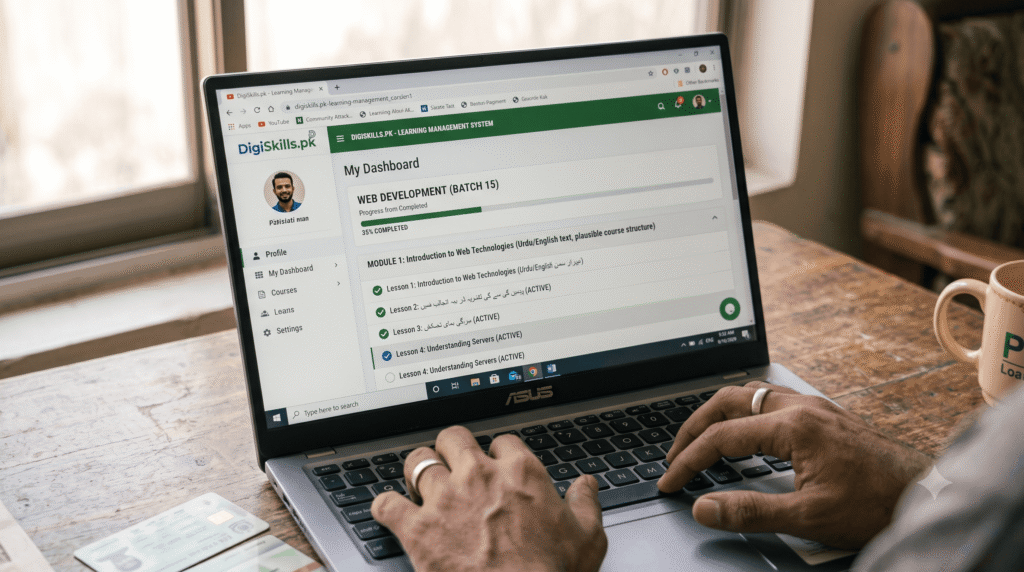
All courses are free. Delivered online via video lessons. Assignments submitted through the platform. Certificates issued upon completion of assignments and assessments.
Who it’s for: Anyone. Literally — there’s no age cutoff, no income requirement, no minimum education for most courses. If you have a phone or computer and internet access, you can enroll.
How to enroll:
- Go to digiskills.pk
- Create an account with your CNIC (for Pakistanis) or passport (for overseas)
- Wait for the enrollment window for your preferred course — not all courses run simultaneously. Each batch has an enrollment window that opens for a limited time.
- Enroll during the window
- Complete the 3-month course through video lessons and assignments
- Pass the final assessment to receive your certificate
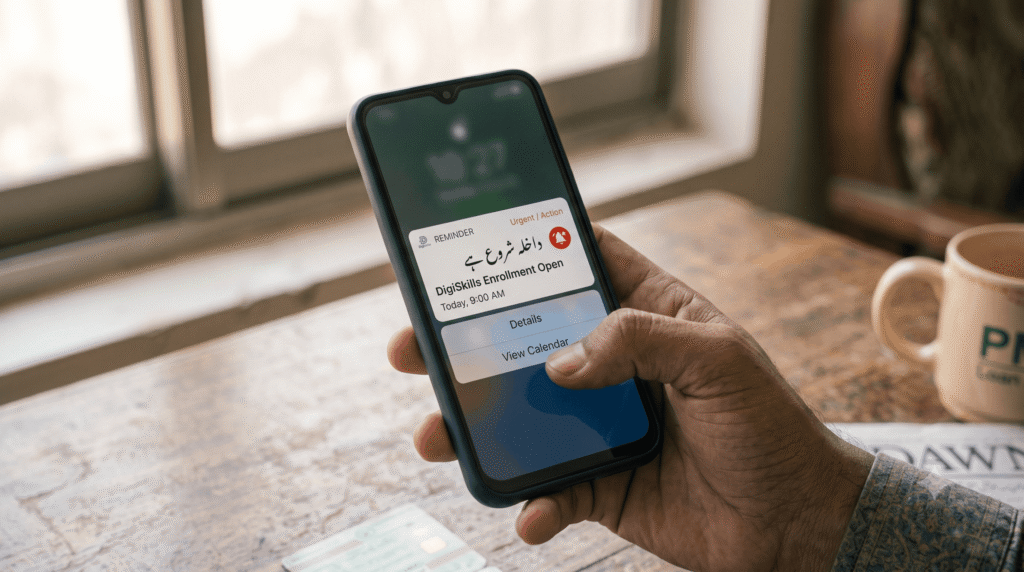
The enrollment window issue: This is what trips most people up. DigiSkills runs in batches. Enrollment opens for 1–2 weeks, then closes. If you don’t enroll during the window, you wait for the next batch. Check digiskills.pk regularly and enroll the moment a window opens for the course you want.
What Asad found most useful: The Freelancing course specifically covers not just technical skills but the business side — how to create a profile, how to write proposals, how to price your work, how to communicate with international clients. That practical business layer is what made the difference between “I can do this skill” and “I can earn from this skill.”
Program 2: PSDF IT Courses (Punjab)
The Punjab Skills Development Fund (PSDF) at psdf.org.pk runs fully funded IT and technical training programs in Punjab through a network of registered training providers.
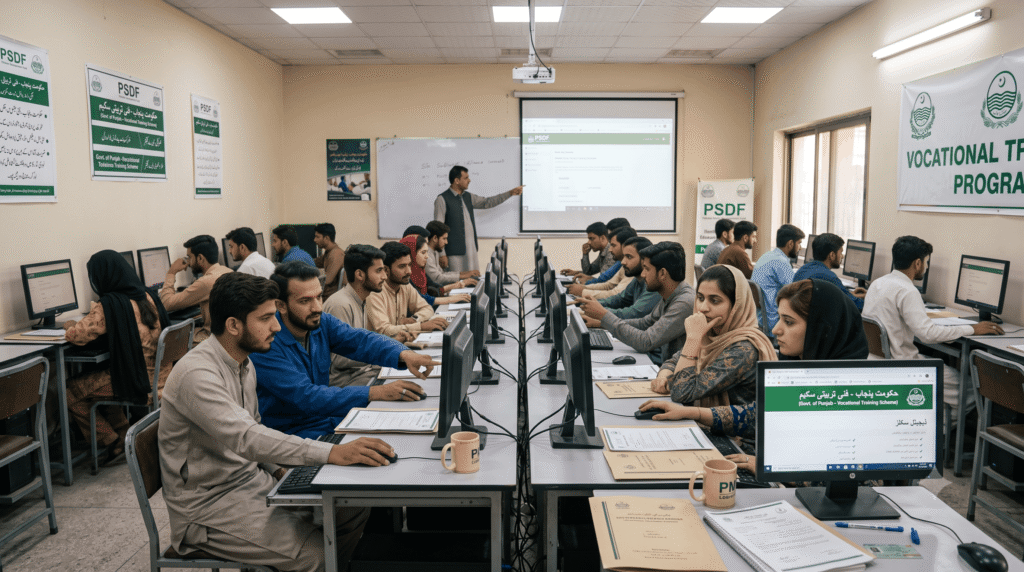
Unlike DigiSkills (which is online), PSDF training is primarily in-person at registered training centers in cities across Punjab.
Courses include:
- Web Development (HTML, CSS, JavaScript, PHP)
- Mobile App Development (Android)
- Graphic Design (Adobe Suite)
- Computer Hardware and Networking
- Data Entry and Office Automation
- Cybersecurity fundamentals
- Various software-specific training (AutoCAD, QuickBooks, etc.)
Duration: 1 to 6 months depending on the course
Stipend: Students enrolled in PSDF programs receive a daily transport stipend to cover commuting costs — typically Rs. 100 to Rs. 200 per day depending on the course and location.
Eligibility: Punjab resident, age 15–45, minimum literacy (some courses require specific prior education). Applications prioritize lower-income applicants and women.
How to enroll:
- Go to psdf.org.pk
- Find courses available in your city/district
- Apply through the portal or visit the PSDF-registered training center directly
- Short-listed applicants go through a brief interview/screening
- Enrollment confirmed for selected applicants
The physical attendance factor: PSDF courses require in-person attendance at a training center. This is not suitable for everyone — particularly people in small towns where training centers may not be located nearby. But in cities with centers, it offers structured learning with a classroom environment that many people find more effective than self-paced online learning.
Program 3: NAVTTC IT Programs (Federal, All Pakistan)
The National Vocational and Technical Training Commission (NAVTTC) at navttc.gov.pk runs free training programs across Pakistan at the federal level, including IT and technology tracks.
NAVTTC operates through NAVTTC-registered training institutes across the country — including in KPK, Balochistan, Sindh, AJK, and Gilgit-Baltistan where PSDF (Punjab-specific) isn’t available.
IT-relevant courses:
- Computer Applications and Office Automation
- Web Development
- Graphic Design
- Computer Hardware Repair
- Network Administration
- Data Entry
Who it’s for: Pakistani nationals of any province. Age and education requirements vary by course.
How to access: Check navttc.gov.pk for the list of registered training institutes in your district. Apply through the institute directly or through the NAVTTC portal when batch enrollment is open.
For people in provinces where PSDF doesn’t operate, NAVTTC is often the closest equivalent. The training quality varies by institute but the certification is nationally recognized.
Program 4: Ignite — For Advanced Learners and Startup Founders
Ignite (National Technology Fund) at ignite.org.pk operates at a different level than the entry-level programs above. It’s aimed at people who already have IT skills or are studying technology and want to build startups, access advanced training, or access funding for technology projects.
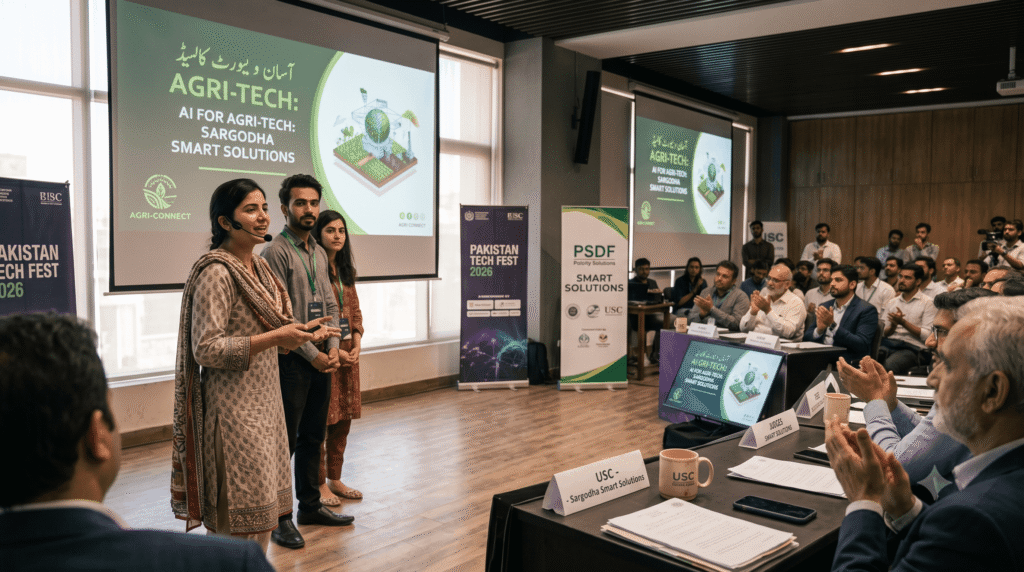
Programs include:
- PASHA ICT Awards — recognition and support for technology businesses
- Startup incubation — grant and support programs for tech startups
- Technology contests and competitions with prize money and mentorship
- Short advanced courses in emerging technologies (AI, cybersecurity, blockchain)
Who it’s for: University students and graduates in IT/CS, existing IT professionals, tech startup founders.
If you’re a complete beginner, start with DigiSkills or PSDF first. Ignite is the right destination after you’ve built foundational skills and want to take them further.
Program 5: Virtual University of Pakistan — Accredited Degrees and Certificates
The Virtual University of Pakistan (VU) at vu.edu.pk is a government university that delivers education entirely online. It’s not free — but it’s significantly cheaper than most private universities, and many of its programs fall within the HEC scholarship coverage.
Relevant programs:
- BS Computer Science (4-year degree)
- BS Information Technology
- BS Software Engineering
- Various short certifications in web development, data science, and related fields
Why it’s in this guide: VU makes degree-level IT education accessible to students who can’t relocate to a university city, can’t afford private university fees, or need to work while studying. The combination of VU enrollment + HEC Need-Based Scholarship covers much of the cost.
For students who’ve done DigiSkills or PSDF training and want to formalize their education into a degree, VU is the natural next step.
The Real Path: How These Programs Connect
Here’s how these programs work as a progression rather than standalone options:
Complete beginner with no IT background: → Start with DigiSkills (free, online, no requirements, immediate enrollment)
Want structured classroom training in Punjab: → PSDF courses at a registered training center near you
Outside Punjab, want government-backed training: → NAVTTC through a registered institute in your district
Have basic skills, want to build a product or startup: → Ignite programs and competitions
Want an actual accredited degree while working: → Virtual University (subsidized fees + HEC scholarship if eligible)
Asad’s path was DigiSkills → freelancing income → currently exploring VU’s part-time BS programs. The income from freelancing is funding his next educational step.
Mistakes That Keep People from Benefiting
Missing the DigiSkills enrollment window. This is the most common and most preventable. Enrollment opens for 1–2 weeks per batch. If you’re waiting to “decide which course to take,” you may wait yourself out of the current batch. Enroll first, then learn. You can always drop a course if it’s not right, but you can’t enroll after the window closes.
Assuming “free” means low quality. DigiSkills courses are developed in collaboration with international certification bodies. The Freelancing course content aligns with Fiverr’s own educational materials. PSDF training is conducted at registered institutes with qualified instructors. “Free” here is government-subsidized, not low-effort.
Not completing the course after enrolling. DigiSkills completion rates are low industry-wide because people enroll and don’t follow through. The certificate requires completing assignments and passing assessments — not just watching videos. Block time in your week specifically for the coursework.
Choosing a course based on what sounds impressive rather than what’s marketable. Someone who completes the DigiSkills WordPress course and immediately starts doing freelance website work for local businesses will earn faster than someone who spent the same time on a more impressive-sounding course that’s harder to monetize without additional experience.
Not applying for PSDF because the training center seems far. Check the full PSDF list before assuming there’s nothing near you. PSDF has expanded significantly — there are training providers in many smaller cities that aren’t widely known.
Treating the certificate as the endpoint. The certificate shows you completed the training. Employers and freelance clients care about what you can do. Build a portfolio — even 3–4 projects — while or immediately after training. The certificate gets you through the first filter; the portfolio gets you the work.
Step-by-Step: Enrolling in DigiSkills Right Now
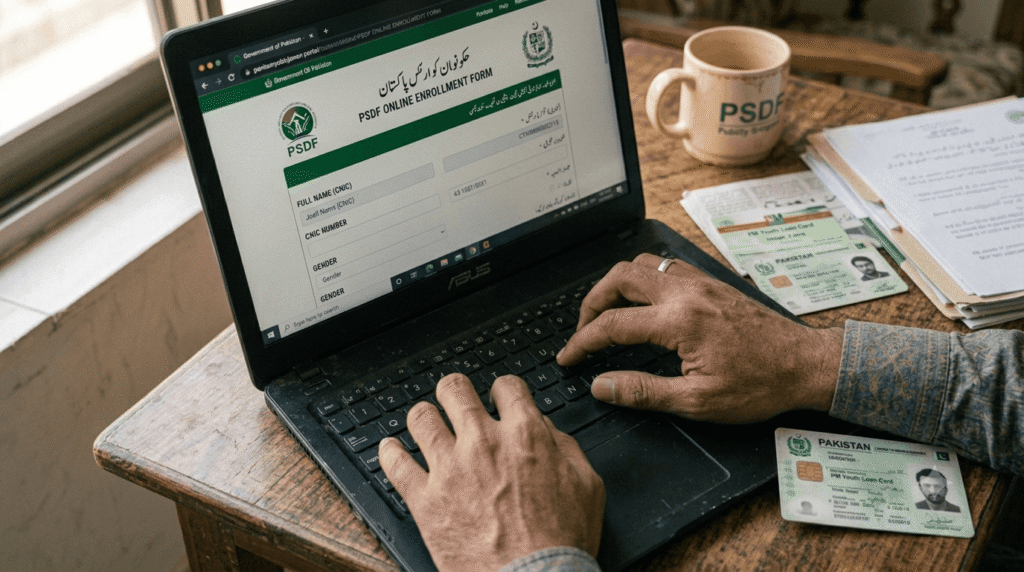
For anyone reading this who wants to take immediate action:
Step 1: Go to digiskills.pk
Step 2: Click “Register” and create an account using your CNIC number and a valid email address.
Step 3: Verify your email — the verification link expires quickly, so check immediately.
Step 4: Log in and check which courses have open enrollment windows. The dashboard shows current course availability.
Step 5: If a course window is open: enroll immediately. Don’t deliberate.
Step 6: If no window is currently open: check back every 2–3 days. Set a phone reminder. Windows open without much advance notice.
Step 7: Once enrolled, download the course schedule and mark your assignment deadlines. Miss an assignment and you may be dropped from the batch.
The whole registration process takes about 15 minutes. The course takes 3 months. The skills last a career.
One More Thing About Asad
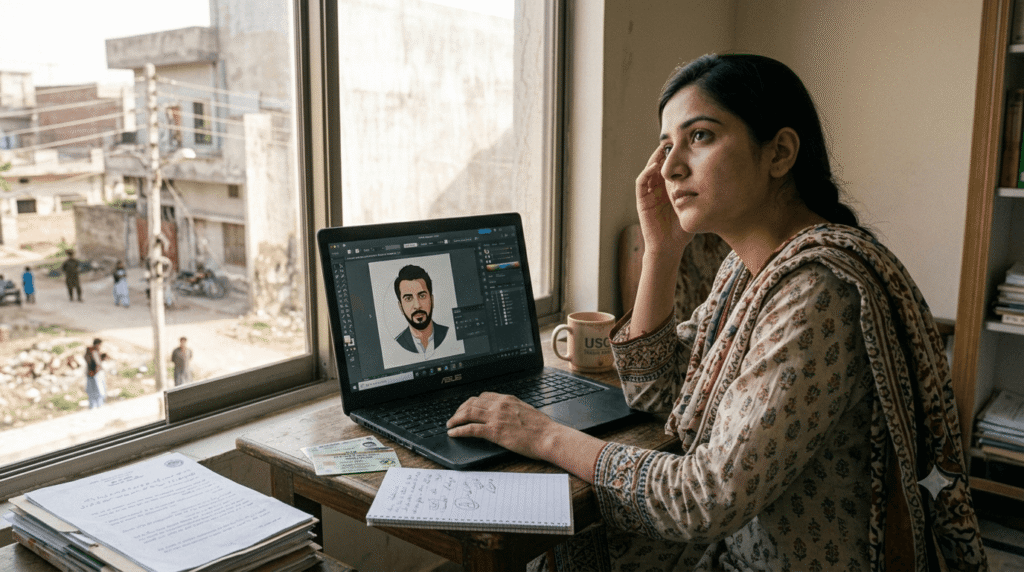
He recently helped his cousin — a young woman in Sargodha who was about to spend Rs. 60,000 on a private graphic design course — look up DigiSkills’ Graphic Design track instead. The private course and the government course teach largely the same Adobe Illustrator and Photoshop content. One costs Rs. 60,000. One is free.
She enrolled in DigiSkills. She’s in week 6 of the course as I write this.
The only real difference between someone who benefits from these programs and someone who doesn’t is knowing they exist and acting on that knowledge before the window closes.
You know now.
Quick Reference
| Program | Level | Delivery | Province | Website |
|---|---|---|---|---|
| DigiSkills.pk | Beginner–Intermediate | Online | All Pakistan | digiskills.pk |
| PSDF IT Courses | Beginner–Intermediate | In-person | Punjab | psdf.org.pk |
| NAVTTC IT Programs | Beginner–Intermediate | In-person | All Pakistan | navttc.gov.pk |
| Ignite Programs | Advanced / Startup | Varies | All Pakistan | ignite.org.pk |
| Virtual University | Degree / Certificate | Online | All Pakistan | vu.edu.pk |
Build in-demand digital skills without paying any course fees. Visit the official DigiSkills portal below to explore free government-sponsored IT courses, enroll online, and earn a recognized certificate after successful completion.
Enroll in Free IT Courses OfficialNot sure which course fits your current skill level or career goal? Drop a comment with where you’re starting from and what you want to achieve — we’ll try to point you toward the right program.