
What’s the point of loan programs that ask for documents small businesses never have?” It’s a fair question, and one that comes up constantly among shop owners who’ve been turned away at the first bank visit.
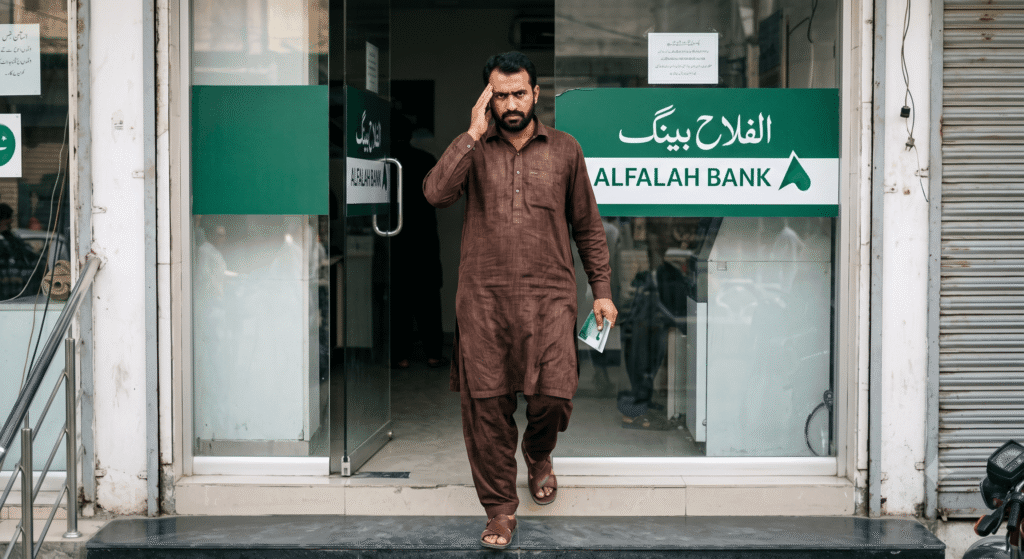
One case: a hardware shop in Lahore, operational nine years, turning over roughly Rs. 500,000 a month, never once late on a supplier payment. Walked into a bank asking about a business loan and walked back out seven minutes later — not rejected outright, just asked for three things that didn’t exist on paper: audited financial statements, a business registration certificate, and two years of tax returns under a specific business category code. On paper, in the format the bank needed, the business barely registered as real.
The frustration is understandable. It’s also not the end of the road — there are financing options built for exactly this kind of business, but accessing them means understanding how the system actually works, preparing differently than a standard bank loan expects, and approaching the right institutions with the right products.
That shop eventually secured a Rs. 700,000 business loan — four months from the first failed bank visit to funds in the account. This guide covers everything that made the difference between the two.
Before Anything Else: Understand What Type of Loan You Actually Need
This sounds obvious but it’s where most people go wrong. “I need a business loan” is not specific enough — and different needs require different products from different institutions.
Working capital loan: You need cash to buy inventory, pay suppliers, or cover operating costs while waiting for receivables. This is revolving — you draw, repay, draw again. Products like the Asaan Karobar Card or bank overdraft facilities are designed for this.
Term loan for equipment or assets: You need a specific amount to buy machinery, vehicles, or equipment. This is a fixed loan with a defined repayment schedule. The PM Youth Business Loan and standard SME term loans handle this.
Expansion capital: You want to open a second location, hire staff, or significantly scale operations. This typically requires larger amounts and stronger documentation than smaller working capital or equipment loans.
Emergency bridge financing: You have a cash flow gap — a large receivable that’s delayed, a one-time expense — and need short-term coverage. Different product, shorter tenure, sometimes a business credit card or overdraft is more appropriate than a term loan.
Know which category applies to you before you approach any institution. It determines what you ask for, what documentation you prepare, and which institution is most likely to help you.
For Kamran, the need was clear: he had an opportunity to buy Rs. 600,000 of branded power tools from a supplier closing a warehouse at a 30% discount. He needed working capital, fast, for a defined purpose. That made it a specific working capital/opportunity loan — not a vague “business expansion” request.
The Main Business Loan Options in Pakistan — Matched to Business Size
Micro and Very Small Businesses (under Rs. 300,000 needed)
If you need less than Rs. 300,000 and your business is informal, home-based, or micro-scale:
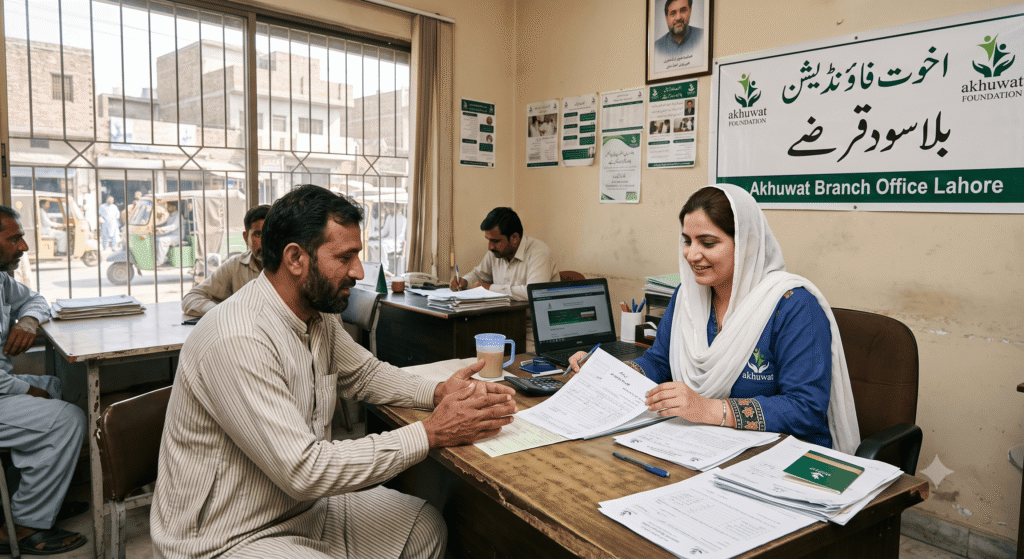
- Akhuwat Foundation — interest-free loans up to Rs. 100,000 with community guarantors. No collateral. No formal accounts needed. Best for informal sector, home-based businesses, and very small traders. akhuwat.org.pk
- Khushhali Microfinance Bank — small business loans up to Rs. 200,000 with relatively light documentation requirements
- U Microfinance Bank — similar products, branch presence in many smaller cities
- NRSP Microfinance — particularly strong in rural and semi-rural areas
For this tier, the main documentation hurdle is proving the business exists — photographs, utility bills, any purchase/sale receipts, and community references.
Small Businesses (Rs. 300,000 to Rs. 1,500,000)
This is the most common tier for established small traders, shopkeepers, and service businesses:
- PM Youth Business Loan (pmkamyabjawan.gov.pk) — Rs. 100,000 to Rs. 1.5 million, 3–5% markup. No strict formal account requirement for Tier 1. Age 21–45.
- Asaan Karobar Card (Punjab) — revolving credit up to Rs. 1 million at subsidized markup. Good for businesses with fluctuating working capital needs.
- SBP SAAF (SME Asaan Finance Facility) — through participating banks, streamlined documentation, up to Rs. 1.5 million.
For this tier, bank statements (even personal, but business-related transactions visible) and an NTN registration significantly strengthen your application.
Established Small-Medium Businesses (Rs. 1.5 million and above)
Businesses with operational history, some formal documentation, and clear revenue streams:
- Commercial bank SME loans (Habib Bank, MCB, Bank Alfalah, UBL, etc.) — larger amounts, more rigorous documentation, standard commercial markup rates unless accessing SBP refinancing
- SBP refinancing-backed products through the same banks at reduced rates
- SMEDA-facilitated financing — SMEDA helps businesses prepare bankable proposals and connects them with appropriate financing institutions
What Banks and Lenders Actually Need — And Why
Here’s the mental model that makes everything else make sense.
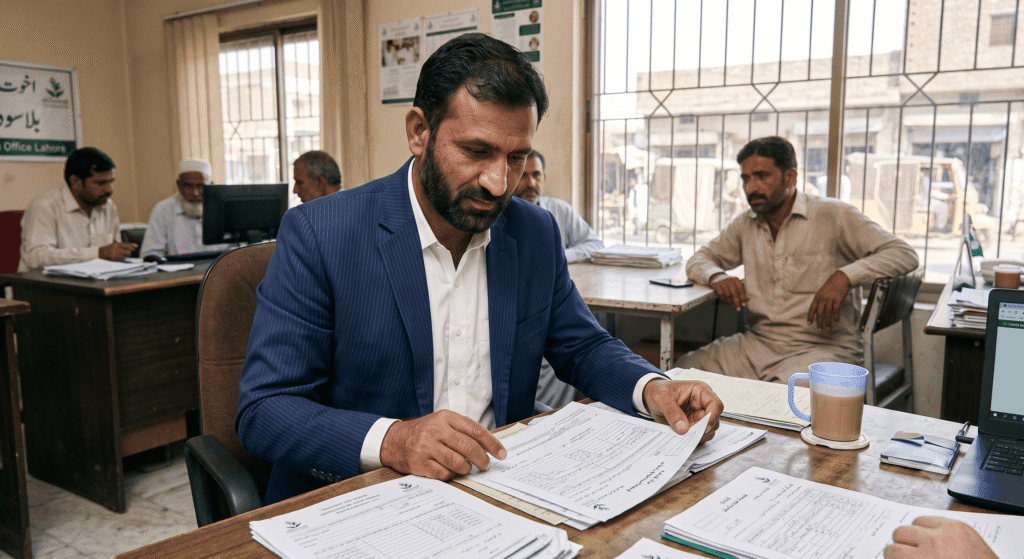
A lender asks one core question before approving any loan: “Will this business generate enough cash to repay us?”
Everything they ask for — documents, statements, tax returns, business plans — is trying to answer that question. If you understand that, you can think about documentation not as bureaucratic hurdle-clearing but as evidence-building. You’re building a case that yes, this business generates income, yes, it can service the repayment, and yes, the information you’re providing is verifiable.
Business bank statements show cash flow — money coming in, money going out, and the pattern of business activity over time.
Tax returns and NTN show the business has a legal existence that can be cross-referenced. Even a simple NTN registration (free, quick at iris.fbr.gov.pk) signals that the business is real.
Business purpose / business plan tells the lender what the money is for and how it will generate returns. “I want to buy power tools at a 30% discount from a closing warehouse and resell them through my existing customer base” is a concrete, understandable story. A lender can assess it.
Collateral (for secured loans) answers “what if they don’t repay?” For unsecured scheme loans (SAAF, PM Youth Loan, Akhuwat), collateral is replaced by community guarantors, government risk-sharing, or the scheme’s specific underwriting criteria.
Step-by-Step: How Kamran Got His Rs. 700,000 Loan
Step 1: Get NTN if you don’t have one.
Kamran’s hardware shop had been running for 9 years but he’d never registered for NTN. He assumed it was only for larger businesses. It’s not — NTN is for any business income, and obtaining it costs nothing.
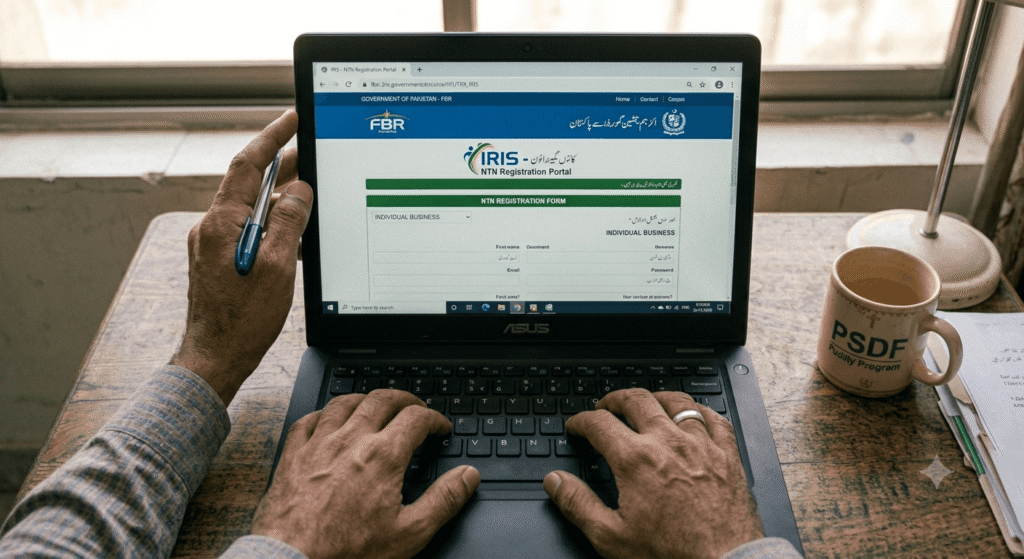
He registered at iris.fbr.gov.pk online. Took 4 days to process. Cost: zero.
This single step made him a dramatically more credible loan applicant.
Step 2: Open a dedicated business bank account.
Kamran’s business revenue had been going into his personal savings account for years. When a lender sees a personal account statement, they see personal income — not a business.
He opened a current account at the bank where he planned to apply (Bank Alfalah, because they participate in the SBP SAAF scheme). He started running all business transactions through it immediately.
For the loan application, he submitted 3 months of business current account statements. Not enough to fully demonstrate long-term cash flow, but enough to establish a baseline — especially combined with his personal account statements showing 9 years of supplier-related transactions.
Step 3: Gather supplier evidence.
Kamran’s strongest asset was his supplier relationships — nine years of consistent purchasing.
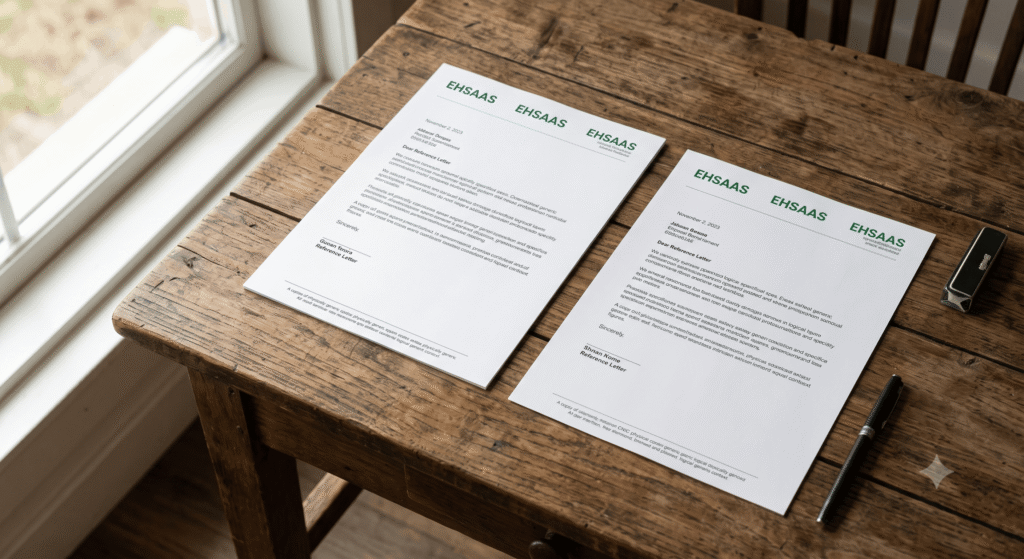
He asked his two main suppliers for reference letters on their letterheads confirming the business relationship, typical monthly purchase volumes, and payment history.
This is something most loan guides don’t mention. Supplier references are extremely effective because they’re third-party verification of both business activity and creditworthiness. A supplier who says “Kamran has been buying Rs. 200,000 to Rs. 400,000 of stock from us monthly for 9 years, always on time” is making a stronger statement than any bank statement.
Step 4: Write a one-page loan purpose statement.
Not a formal business plan — just a clear one-page explanation:
- What is the business?
- What is the specific loan for?
- Why does this purchase make sense financially?
- How will the loan be repaid?
Kamran’s version: “Nine-year-old hardware retail business, monthly turnover approximately Rs. 400,000–500,000. Opportunity to purchase Rs. 600,000 of branded power tools from [supplier name] at 30% below normal wholesale due to warehouse closure. These products sell through my existing customer base (licensed contractors and workshop owners) at full margin. Expected to sell through within 60–90 days based on my current sales velocity of similar products. Loan repayment from sales proceeds over 12 months.”
Clear. Specific. Logical. That’s all it needed to be.
Step 5: Visit the bank with everything organized.
He went to Bank Alfalah, asked specifically for the SME or SAAF facility officer, and came with:
- CNIC (original)
- NTN certificate
- 3 months business current account statements
- 12 months personal savings account statements (showing business-related transactions)
- Shop rental agreement
- Utility bill for the shop
- Two supplier reference letters
- One-page loan purpose statement
- Photographs of the shop interior showing stock
The credit officer appreciated that he’d come prepared. The field visit was scheduled for the following week.
Step 6: Field visit — be present and be specific.
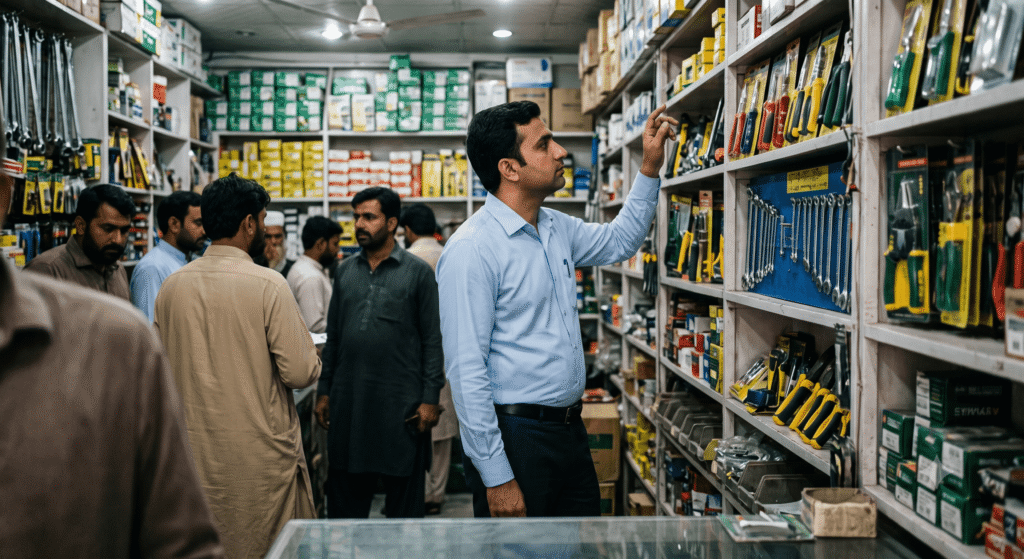
The bank’s field officer visited the shop on a busy Saturday morning (Kamran’s suggestion — he wanted the officer to see the actual customer traffic). He walked the officer through his stock, showed him the current inventory value, introduced him to a regular contractor customer who was in the shop.
The officer asked about the power tool opportunity. Kamran showed him the supplier’s written offer with pricing. The officer photographed everything.
Step 7: Credit assessment and approval.
Three weeks after the field visit, Kamran received a call from the bank. Approved: Rs. 700,000 (slightly above his Rs. 600,000 target, giving him working capital buffer). Markup: 9% per annum under SBP SAAF. Tenure: 18 months. Monthly installment: approximately Rs. 42,000.
He signed the sanction letter. Funds disbursed within a week.
He bought the power tools. They sold through in 68 days. His additional profit from the discounted purchase: approximately Rs. 180,000.
The loan paid for itself before the third installment.
Documents You Need — The Master Checklist
For micro/informal business (Akhuwat, microfinance):
- CNIC
- Utility bill (residence or business)
- Two community guarantors
- Business photographs
- Any receipts or transaction evidence
For small business (PM Youth Loan, SAAF, Asaan Karobar Card):
- CNIC
- NTN certificate
- Business bank account statements (3–12 months)
- Shop rental agreement or ownership documents
- Utility bill (business address)
- Business purpose description
- Supplier references (if available)
- Tax return for last 1–2 years (if filed)
For established SME (commercial bank SME loans): Everything above, plus:
- 2–3 years of tax returns
- Audited or reviewed financial statements (for larger amounts)
- Collateral documentation (property, vehicle, machinery) if applicable
- Trade license or business registration
Mistakes That Get Applications Rejected or Delayed
Not having NTN. Free to obtain, takes less than a week, dramatically improves credibility. No excuse to apply without it.
Personal account with mixed business and personal transactions. Open a separate business account. Even 3 months of clean business account history is better than years of mixed personal account statements.
Asking for too much. The loan amount should be proportionate to your demonstrable revenue. Asking for Rs. 2 million when your business shows Rs. 150,000 monthly revenue will be rejected. Know your ceiling.
Vague loan purpose. “I need money for my business” is not an application. “I need Rs. 600,000 to purchase specific inventory at a one-time discount from a named supplier, expected to sell through in 90 days based on current sales velocity” is an application.
Going to the wrong institution for your size. A Rs. 80,000 need at a commercial bank’s SME desk is likely to be ignored — the loan is too small to be worth their processing cost. The same amount at Akhuwat or a microfinance institution is exactly the right size. Match your scale to the right institution.
ECIB surprises. Unknown credit issues — old telecom installments, forgotten informal loans that were reported — surface at the worst moment. Check your ECIB status at the State Bank’s consumer portal before applying anywhere.
Not having a business bank account at all. This is the single most fixable problem and the one that eliminates more applicants than any other. Open a business account first. Run transactions through it. Apply after 3–6 months of history.
A Final Practical Note
The gap between “I need a business loan” and “I have a business loan” is mostly a preparation gap.
Banks and lenders make decisions based on evidence. The more clearly you can demonstrate that your business is real, generates income, and can service a repayment — with verifiable, organized documentation — the more your application looks like an obvious approval rather than a risk.

Kamran’s hardware shop was exactly the same business before and after the loan. What changed was how visible that business was on paper. NTN registration, a business bank account, supplier references, a one-page purpose statement. None of it was complicated. None of it was expensive.
The loan followed the preparation. It usually does.
Trying to figure out which loan option fits your specific business or stuck at a particular step? Drop a comment with your situation — type of business, how long you’ve been running, roughly how much you need — and we’ll try to point you toward the most relevant option.
Planning to apply for a business loan? Use the official government portal below to explore available loan schemes, review the application requirements, and submit your application with confidence.
Apply for a Business Loan Official