
A retired school peon in Rawalpindi needed a heart bypass surgery last year. The question wasn’t really whether he needed it — the diagnosis was clear. The question was whether the family could afford it.
His pension: Rs. 14,000 a month. No savings worth mentioning — retirement had stopped the salary, not the expenses. His wife managed the household on what was left after basics.
The cardiologist’s estimate for bypass surgery at a private hospital came to Rs. 600,000-800,000. A number that simply didn’t exist anywhere in the household’s finances.
Then a nurse at the admission desk asked one question: “Does he have the Sehat Card?”
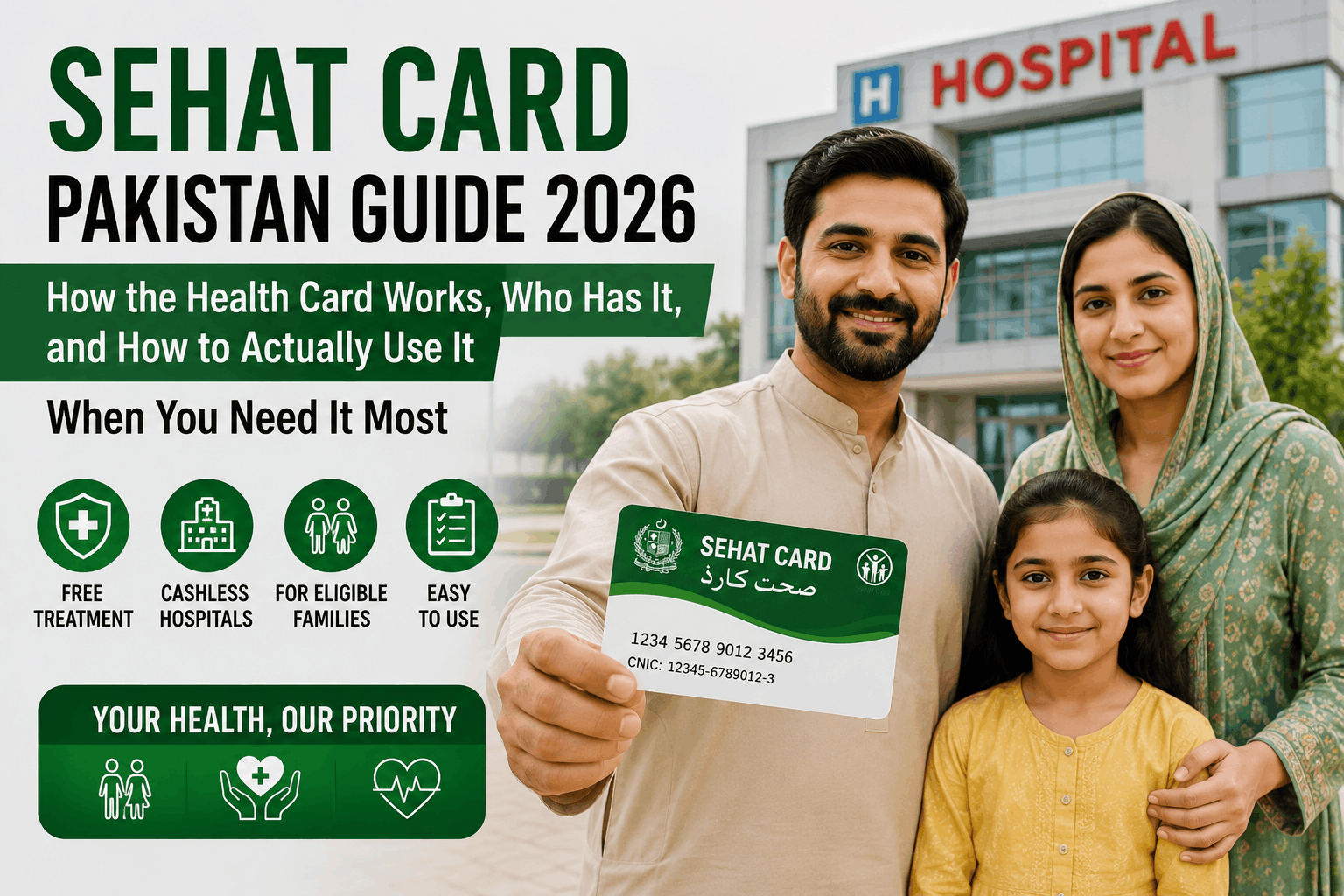
He did. A Sehat Sahulat Program card, issued two years earlier through his Union Council, that had sat untouched since the day it arrived — nobody in the family had thought about it since.
That card covered the entire bypass surgery, the hospital stay, and the follow-up medication during admission. The final bill from the hospital’s Sehat Card counter: Rs. 0.
This guide covers how that program actually works, how to check whether you’re covered, and what to do with the card before — not during — a hospital emergency.
What the Sehat Card Program Is
The Sehat Sahulat Program (commonly called the Sehat Card or Health Card) is Pakistan’s government-funded health insurance program. It covers inpatient treatment — hospitalization, surgeries, and associated in-hospital care — at a network of empanelled hospitals, free of charge for eligible beneficiaries.
The current program provides coverage of up to Rs. 1,000,000 (Rs. 10 lakh) per family per year at participating hospitals across Pakistan.
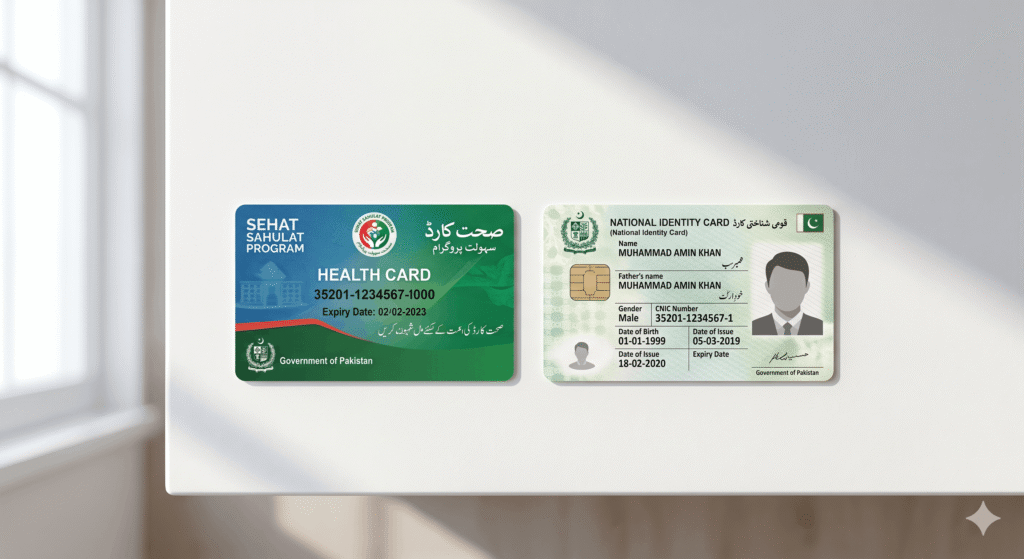
This is health insurance funded by the government. You don’t pay premiums. You don’t pay co-payments at the hospital. The government pays the insurance premium on your behalf, and when you need hospitalization, the insurance covers the cost up to the annual limit.
The program is run by the State Life Insurance Corporation on behalf of the government, and administered regionally under the Ehsaas/BISP umbrella for the most vulnerable families, and through provincial health authorities (like the Punjab Health Initiative Management Company — PHIMC — in Punjab) for broader provincial coverage.
Who Is Covered — And Why the Answer Is More Complicated Than It Should Be
This is where most guides give a simple answer and confuse people. The honest answer is: it depends on which version of the Sehat Card program you’re asking about, because there are two overlapping tracks:
Track 1: Punjab Sehat Card (Universal Coverage in Punjab)
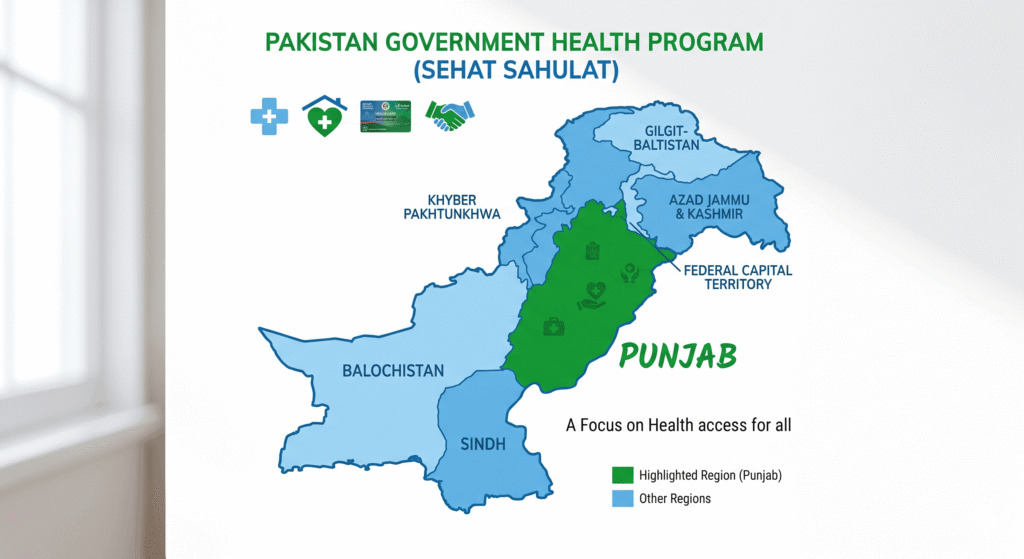
In Punjab, the Sehat Card has been expanded to cover all registered families in Punjab — not just low-income households, but everyone with a Punjab CNIC and a Union Council registration.
This is the track my uncle was on. His CNIC showed a Rawalpindi address. His Union Council issued the card as part of Punjab’s universal enrollment.
If you live in Punjab and have a Punjab CNIC: you are likely covered or eligible to be covered under the Sehat Card program regardless of income.
Check your coverage: You can verify whether your family is enrolled by:
- Going to sehat.punjab.gov.pk and entering your CNIC
- Visiting your nearest Union Council office and asking for Sehat Card enrollment status
- Calling the Sehat Card helpline: 0311-1117771
Track 2: Federal Ehsaas Sehat Sahulat Program (Income-Targeted, All Pakistan)
For the rest of Pakistan (KPK, Sindh, Balochistan, AJK, GB) and for the lowest-income households specifically, the federal Ehsaas Sehat Sahulat Program covers families registered in the NSER below the poverty line — essentially the same population as BISP Kafaalat beneficiaries.
If you receive BISP Kafaalat, you are likely enrolled in the federal Sehat Sahulat Program.
Check your coverage: Go to sehat.gov.pk or send your CNIC to the helpline. Your BISP status is linked to your Sehat Sahulat coverage.
The Key Question to Ask Yourself
- Are you in Punjab? → Likely universally covered regardless of income
- Are you in another province and a BISP beneficiary? → Likely covered under federal program
- Are you in another province and not a BISP beneficiary? → Check what your provincial health authority offers — KPK had its own Sehat Card (now integrated with the federal program), Sindh has separate health coverage schemes
For the purposes of this guide, we’ll primarily walk through how the program works once you’re confirmed as covered.
What the Card Actually Covers
Understanding coverage limits prevents the shock of finding out something isn’t covered after you’ve already been admitted.
What is covered:
- Inpatient hospitalization (you must be admitted — this is not for outpatient/clinic visits)
- Surgical procedures — the list is extensive and includes cardiac surgery, orthopedic procedures, cancer treatment, kidney disease, maternity complications, and many more
- Up to Rs. 1,000,000 per family per year at empanelled hospitals
- Room charges, surgical fees, anesthesia, medications during admission, laboratory tests during the hospitalization
What is NOT covered:
- Outpatient consultations and clinic visits (you pay for doctor’s visits normally)
- Routine medicines prescribed for home use
- Procedures and treatments not on the approved list
- Treatment at non-empanelled hospitals
- Dental procedures (with very limited exceptions)
- Elective cosmetic procedures
The family in this context means the registered household — typically husband, wife, and children. Confirm with the hospital’s Sehat Card desk how they count the family unit.
Which Hospitals Can You Use?
This is arguably the most practically important piece of information and the one people most often don’t have when they actually need it.
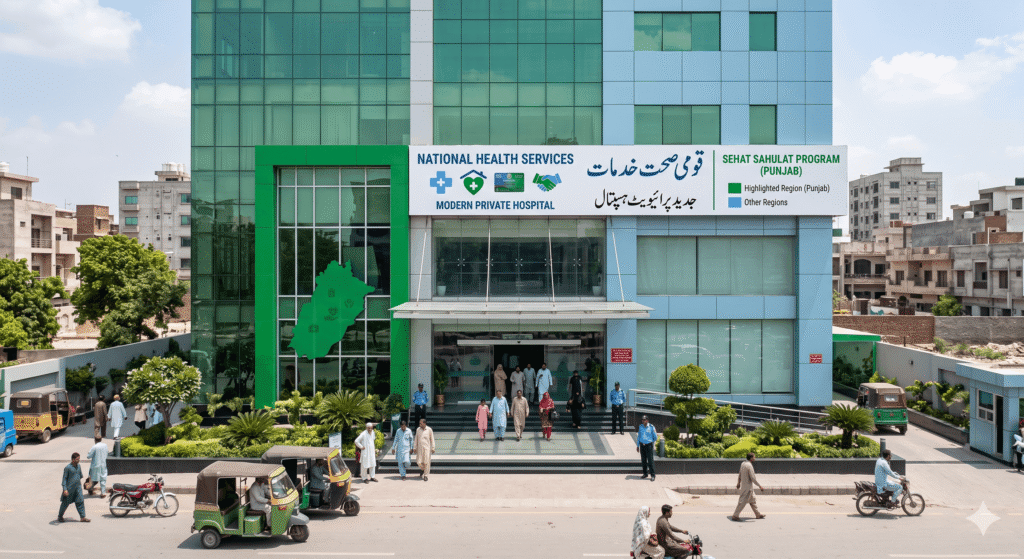
The Sehat Card only works at empanelled hospitals — hospitals that are registered with the program and have a dedicated Sehat Card desk. Treatment at a non-empanelled hospital is NOT covered, even if you have the card.
How to find empanelled hospitals:
- Go to sehat.punjab.gov.pk (for Punjab) or sehat.gov.pk (federal) and look for the hospital finder
- Call the helpline (0311-1117771) and ask for empanelled hospitals in your city
- Ask at your District Health Office
- Many large private hospitals and all major government teaching hospitals in cities are empanelled — but verify before traveling
The network includes both government hospitals (where treatment is already free in many cases) and private hospitals (where the Sehat Card allows access to private-quality care at no cost). The private hospital empanelment is what makes the card genuinely valuable.
When my uncle had his surgery, the family chose an empanelled private hospital in Rawalpindi over the government option because the private hospital’s cardiac unit had a shorter waiting list and more experienced surgeons for this specific procedure. The Sehat Card covered both options equally.
How to Use the Card When You Actually Need It
This is the step-by-step process for when someone in your family needs hospitalization.
Step 1: Confirm the Hospital Is Empanelled
Before going to any hospital for the Sehat Card, confirm it’s on the empanelled list. Call the hospital directly and ask: “Do you accept the Sehat Sahulat Card?” Get a verbal confirmation. Then also check the official list to cross-verify.
Step 2: Go to the Hospital’s Sehat Sahulat Desk
Every empanelled hospital has a dedicated Sehat Sahulat or Health Card desk — usually near the reception or admission area. This is your first stop when arriving for treatment.
Bring:
- Original CNIC of the patient (must be the registered beneficiary or their registered family member)
- The physical Sehat Card if you have it (some families were issued physical cards; others are verified biometrically)
Step 3: Biometric Verification
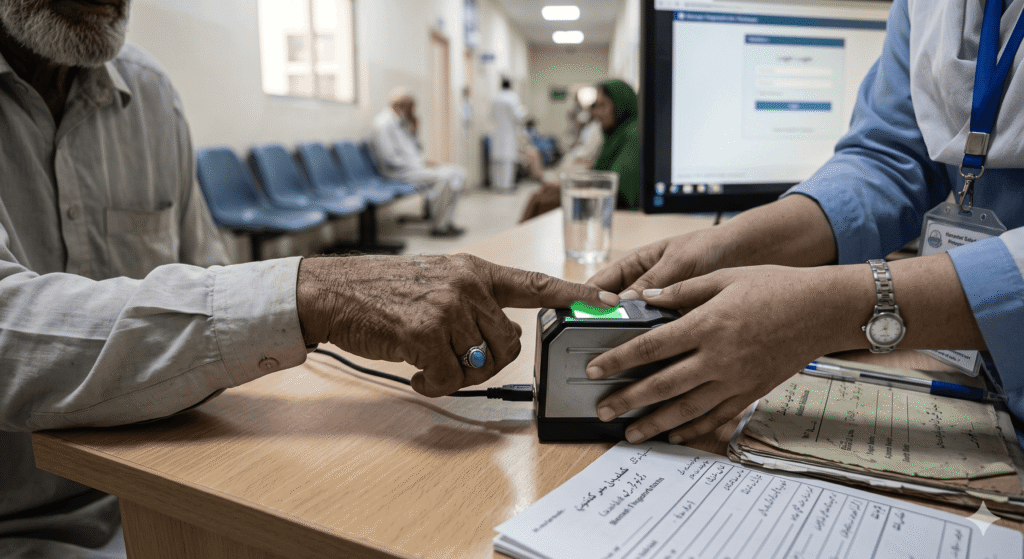
The hospital’s Sehat Card system will perform a biometric verification — the patient’s fingerprint is scanned and matched against the NADRA database. This confirms identity and confirms enrollment in the program.
This is the step that sometimes fails — if someone’s fingerprints are worn (common in the elderly or people who do manual labor), the biometric may not read clearly. In these cases, the hospital’s desk can use alternative verification methods — usually CNIC number plus a secondary check. Mention this proactively if fingerprint scanning has been an issue before.
Step 4: Treatment Approval
The hospital’s system sends an authorization request to the insurer (State Life). For most standard procedures, authorization comes within a few hours. For more complex or higher-cost procedures, it may take longer.
The hospital handles this process — you don’t need to contact the insurer yourself. The Sehat Card desk coordinates the authorization.
Step 5: Treatment and Discharge
Once authorized, treatment proceeds normally. At discharge:
- The hospital submits the claim directly to the insurer
- Your bill, for covered services within the annual limit, is Rs. 0
- If there are any charges for services outside coverage (medications to take home, items not on the approved procedure list), you’ll be told about these separately
What Happened With My Uncle’s Surgery — The Real Version
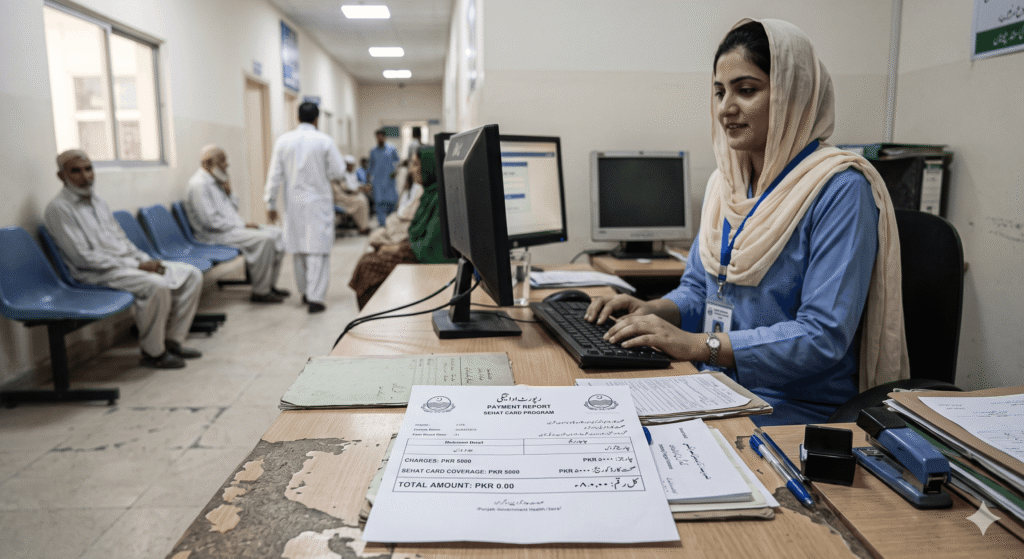
The nurse who asked about the Sehat Card became the person who walked my aunt through the whole process. She took them to the Sehat Card desk, confirmed enrollment using my uncle’s CNIC, completed the biometric verification (two attempts because his fingerprints are worn from decades of manual work), and got the authorization process started.
It took about four hours for full authorization to come through. During that time, the preliminary workup was being done anyway.
Surgery was the next morning.
Three-day post-surgery observation period — fully covered.
At discharge: the billing desk printed a statement showing the full hospital bill and the Sehat Card coverage. The family’s portion: Rs. 0.
The only thing my aunt paid was the taxi fare home.
One thing that almost went wrong: the family didn’t know the hospital’s cardiac unit was empanelled until the nurse asked. They’d initially planned to go to a different private hospital — a more well-known name — which turned out not to be empanelled. If they’d proceeded there, the card wouldn’t have applied.
The lesson: Always confirm empanelment before choosing a hospital for a non-emergency procedure. For emergency situations (ambulance, emergency room), you can verify during admission.
How to Get the Card If You Don’t Have One
If you believe you should be covered but don’t have a physical card:
For Punjab residents:
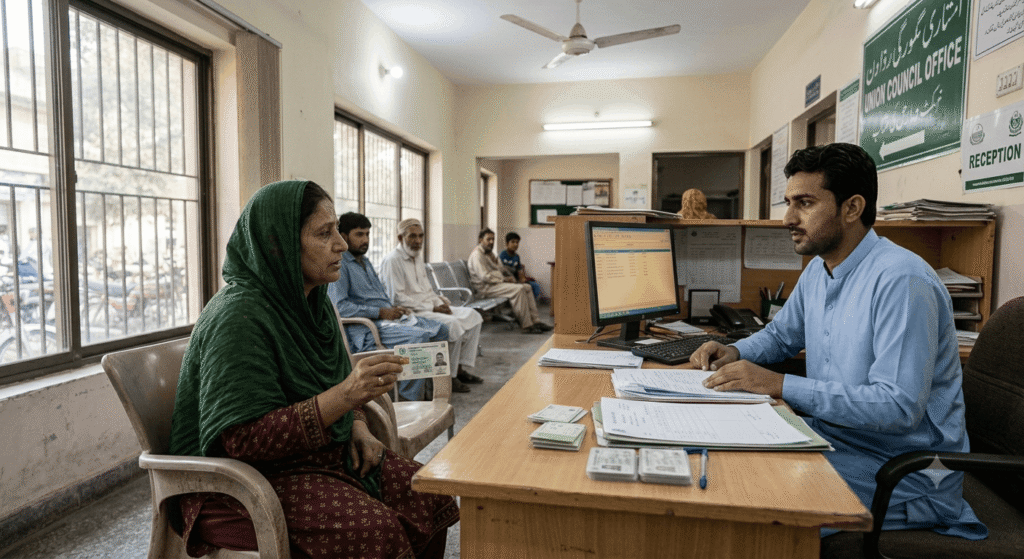
- Visit your Union Council office and tell them you want to be enrolled in the Sehat Card program
- Bring your CNIC and a family registration document (CNIC numbers of spouse and children)
- The UC office processes enrollment through the PHIMC system
- You may be issued a physical card, or enrollment may be recorded biometrically (card becomes your CNIC + fingerprint)
For BISP/Ehsaas beneficiaries (all Pakistan): Coverage is typically automatic if you’re in the BISP system. Verify at sehat.gov.pk or by calling the helpline. If you’re a confirmed BISP beneficiary but showing as not covered, visit the nearest BISP Tehsil Office.
For KPK/Sindh/Balochistan residents not on BISP: Check with your Provincial Health Department or District Health Office about what coverage is available. Coverage programs vary by province and have changed over different government periods.
Common Mistakes That Create Problems at the Hospital
Going to a non-empanelled hospital. The most common and most expensive mistake. The card simply doesn’t work there. Confirm empanelment before going.
Not bringing the original CNIC. The Sehat Card desk needs the patient’s CNIC. Not a copy, not a photograph — the original for biometric verification setup. Carry it.
Trying to use the card for outpatient visits. The program covers inpatient (admitted) treatment only. A clinic visit, a specialist consultation, a scan or blood test outside of hospitalization is not covered. This surprises people who assume the “health card” means all healthcare.
Not disclosing the Sehat Card at admission. Some families go through the regular admissions process without mentioning the card and only bring it up at discharge. By then, the billing has been processed differently and converting it is complicated. Always mention the Sehat Card at your first interaction with the hospital’s admission desk.
Assuming coverage is unlimited. Rs. 1,000,000 per year per family is substantial, but very long hospitalizations or multiple family members requiring major treatment in the same year can approach this limit. Knowing the limit helps with planning for extremely high-cost situations.
Not checking annual limit remaining. If your family has already used some coverage during the year, you can check the remaining balance through the helpline or the online portal. Important to know before a planned procedure.
Quick Reference
| Question | Answer |
|---|---|
| Maximum coverage | Rs. 1,000,000 per family per year |
| Does it cost anything? | No — government-funded, no premiums |
| Inpatient or outpatient? | Inpatient only (must be admitted) |
| Punjab residents covered? | Yes — universal enrollment |
| Non-Punjab, not on BISP? | Check provincial program |
| How to find hospitals | sehat.punjab.gov.pk / sehat.gov.pk / helpline |
| Helpline | 0311-1117771 |
| Biometric issue at hospital? | Ask for alternative CNIC-based verification |
| Not enrolled yet? | Visit Union Council (Punjab) or BISP Tehsil Office |
The bypass surgery cost Rs. 0. My uncle is recovering well. He walked his youngest granddaughter to school last month for the first time since the surgery.
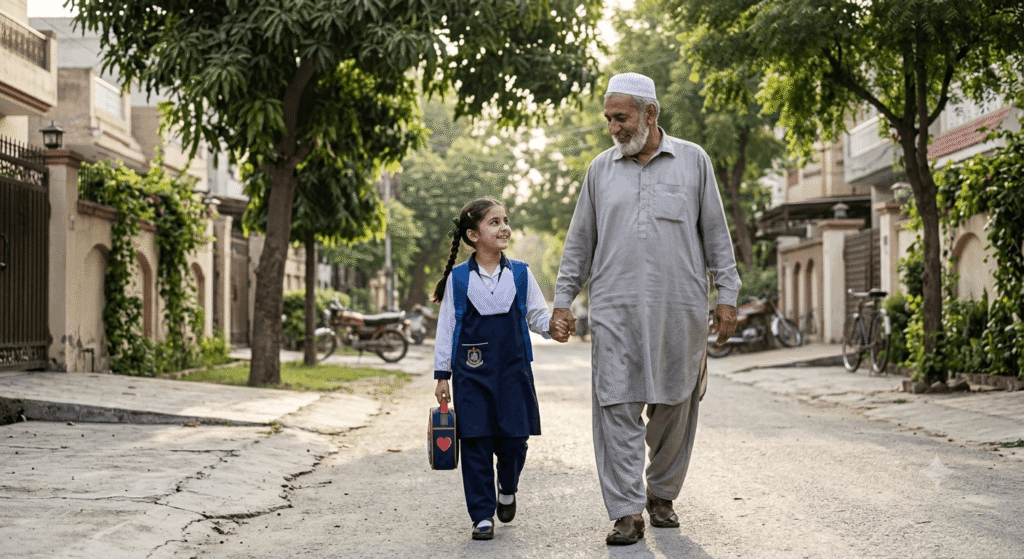
The card that sat unused in a drawer for two years covered the most expensive event of his life.
Knowing you have it and knowing how to use it are two different things. This guide is the second part. The first part — finding out whether you have it — takes one CNIC check and five minutes.
Do that today. Not when someone’s in a hospital corridor at 11 PM trying to figure it out under pressure.
Need complete information about the Sehat Card Program? Visit the official Sehat Sahulat portal below to check your eligibility, find panel hospitals, learn about covered treatments, and access the latest program updates.
Visit Official Sehat Card Portal OfficialNot sure whether you’re enrolled or have a question about coverage in your city? Leave a comment and we’ll try to help you verify your status.